Pools — a row that references a whole record
A generator produces a value. A sequence is a column of those values. That covers most of what a config needs — and then it runs into a wall.
Two thousand patients are seen by thirty doctors. Each patient row needs the doctor's
first name, last name, and room number. Three sequences side by side give you three
independent draws, so a row ends up with one doctor's first name next to another
doctor's room. The data looks plausible and is nonsense: Dr. John Williams, room 118
where no such doctor exists.
The missing idea is that a doctor is not a value, he is a record — and thirty of
them exist before the first patient does. <pool> is that table.
<tdc>
  <env count="8" seed="clinic" local="en">
    <pool name="Doctors" count="4">
      <sequence name="firstName"><gen type="template" value="person.male.firstName"/></sequence>
      <sequence name="lastName"><gen type="template" value="person.lastName"/></sequence>
      <sequence name="room"><gen type="number" value="100..199"/></sequence>
    </pool>

    <sequence name="Patient"><gen type="template" value="person.female.firstName"/></sequence>
    <sequence name="Seen"><gen type="pool" value="Doctors"/></sequence>
  </env>
  <block>
    <line><data>${{Patient}} -> Dr. ${{Seen.firstName}} ${{Seen.lastName}}, room ${{Seen.room}}</data></line>
  </block>
</tdc>
Barbara -> Dr. James Johnson, room 100
Mary -> Dr. Michael Smith, room 186
Margaret -> Dr. Robert Brown, room 148
Jennifer -> Dr. John Williams, room 154
Elizabeth -> Dr. Michael Smith, room 186
Patricia -> Dr. Michael Smith, room 186
Susan -> Dr. John Williams, room 154
Linda -> Dr. James Johnson, room 100
The values come from a fixed seed, so they're reproducible, but exact strings can
differ between core versions. Treat them as examples of shape, not guarantees.
Four doctors serve eight patients, and each doctor's three fields stay glued together. James Smith is in room 197 on every row where he appears, because the row picked Smith — not "a first name, a last name, and a room".
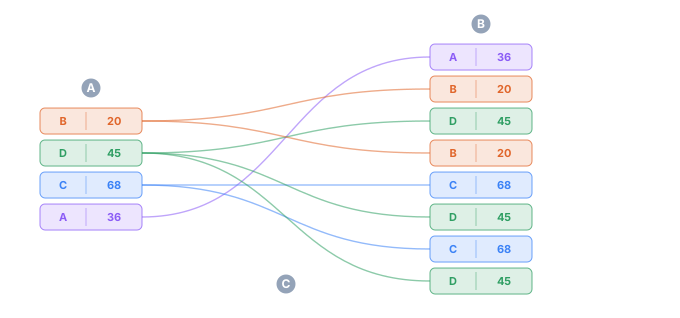
- Athe pool: four members, built once before the run
- Bthe generated rows
- Cone pick per row — both cells of a row always come from the same member
Two things happen, in this order
- The pool is built. Before any row exists, TDC materializes
countmembers. This happens once, whether the run is 8 rows or 8 billion. - Each row draws one member. A
<gen type="pool">gives its sequence one whole member per row, and publishes every field of that member underRef.field.
Everything else on this page follows from those two sentences.
At a glance
<pool> lives directly in <env>, beside
<sequence>. It is never read directly; a sequence draws from it.
On <pool> | Required | What it does |
|---|---|---|
name | yes | The name a <gen type="pool"> names in value |
count | yes | How many members the table holds |
comment | no | Free-text note |
On <gen type="pool"> | Required | What it does |
|---|---|---|
value | yes | The pool to draw from |
filter | no | Which members this row may draw from — Narrowing |
parent | no | Leave some rows without a member at all — Narrowing |
A pool is a miniature <env>
This is the design decision worth knowing, because it answers most questions before you
ask them. A pool's body is built by the same machinery a config's <env> is built by,
with the member count standing in for the row count.
So everything you already know still applies inside a pool:
| Inside a pool | Means |
|---|---|
<sequence> | a field of each member |
<mix> | a field split by exact percent — across the MEMBERS |
<switch> | a field derived from another field of the same member |
<uniq> · uniq="true" | members that must differ from one another |
<distinct> | two fields of one member that must differ |
if= | a field only some members have |
parent= | a field built over the members another field selected |
<compute> | a field calculated from the member's other fields |
What a pool may not hold is output: no <block>, and no fixture tags. A pool is a
table other columns read, not something written to a file. It also may not contain
another <pool> — pools stay flat tables, and one
points at another instead of nesting.
Two names, one dot
The pool has a name; so does the sequence that draws from it. They are different
things:
<pool name="Doctors" count="4"> … </pool>

<sequence name="Seen"><gen type="pool" value="Doctors"/></sequence>
Doctorsis the table. Nothing in<block>refers to it.Seenis the column that holds one doctor per row. You read its fields as${{Seen.firstName}}.
Two sequences may draw from the same pool, and they pick independently — Seen and
Referred would be two different doctors on the same row, which is usually the point.
Reading the reference without a field is refused, because there is nothing to print:
error[TDC229]: "Seen" draws a whole member from a pool — it has no value of its own to print
--> clinic.tdc:8:16
|
8 |   <block><line><data>${{Seen}}</data></line></block>
|                ^^^^^^^^^^^^^^^^^^^^^^
|
note: Read a field: ${{Seen.name}}.
One pick per row
A sequence holds one value per row. A pool reference is a sequence, so it holds one
member per row — and every ${{Seen.…}} in that row reads the same one.
That single rule is what the construct is for. It is also why "Dmitry Ivanova" — a male first name with a female surname — is not something a pool can produce: the gender, the first name, and the last name are fields of one member, and a row that took the member took all three.
The pick is uniform over the members — a draw, not a rota, because nobody declared a proportion; see declared shares or a draw. It is also seekable: row 900,000,000 finds its doctor without the 899,999,999 rows before it ever existing. That is why a pool costs the same on every engine.
Proportions inside the pool
Because the pool is built by the ordinary machinery, percent works inside it exactly
as it does at the top level. Thirty percent of the doctors are surgeons:
<pool name="Doctors" count="10">
  <mix name="role" percent="30,70">
    <case><gen type="text" value="surgeon"/></case>
    <case><gen type="text" value="therapist"/></case>
  </mix>
  <sequence name="name"><gen type="template" value="person.lastName"/></sequence>
</pool>
The share applies to the ten members, not to the rows. Three doctors are surgeons;
how often those three are seen depends on how the rows draw — and on
filter, which is what turns "three of the doctors are surgeons" into
"patients who need a surgeon get one".
Members that differ from one another
uniq inside a pool means what it means outside: no two members share the value.
<pool name="Rooms" count="6">
  <sequence name="number" uniq="true"><gen type="number" value="100..199"/></sequence>
</pool>
Six distinct room numbers, drawn without replacement. A pool whose members are meant to be different things usually wants this on at least one field — otherwise two members can come out identical, and a row cannot tell them apart.
The pool's own seed
A pool is not drawn from the run's main stream. It derives a seed of its own:
<the run's seed> + "#pool:" + <the pool's name>
A pool named Doctors in a run seeded main is built from main#pool:Doctors. There is
no seed attribute on <pool> — the derivation is the whole mechanism, and writing one
is reported (TDC015).
Why it is derived rather than taken. If the pool drew from the main stream, adding one to a config would shift every column declared below it: the ids would stay and the ages, names and dates would all move, and yesterday's snapshot would stop matching for a reason invisible in the diff. A derived seed makes a pool invisible to everything it does not feed.
Two consequences worth knowing:
- Change the run's
seedand the pool changes with it. That is the point — one number still reproduces the whole run. - Renaming a pool changes its members, because the name is part of the derived seed. Renaming is not cosmetic; if the exact members matter, leave the name alone.
Size
A pool is held in memory for the whole run — that is what makes a row's lookup free. Measured on the reference implementation, a member with four fields costs about 320 bytes.
| Members | Roughly | What happens |
|---|---|---|
| up to 100,000 | up to ~29 MB | nothing; it runs |
| over 100,000 | TDC234, a warning | |
| over 1,000,000 | over ~290 MB | TDC235, refused |
Both messages end the same way, because it is the usual cause: if you meant the number
of rows, that is count on <env>.
The ceiling is about the table, not the run. A pool of thirty doctors serves a billion patient rows at the same cost as a thousand, and works on every engine.
Where to go next
- Narrowing with
filter— which members a row may draw from, and how that differs fromif - Linking pools together — several pools, a pool that draws from a pool, and chains that run three deep