Hierarchical dependencies
An ordinary fake-data library fills every field independently. TDC ties
sequences together in a parent → child
relationship: a child's values are generated only on the rows where the parent took a
given value, and any percentages inside the child are measured against the size of that
filtered subset, not against the whole count.
That is what lets one declarative config model a real dependent distribution: male names only for men, a diagnosis that follows from sex, children with no spouse.
Example outputs below are illustrative. The exact values a generator emits can change from one core version or seed to the next; what the feature guarantees is the counts and the structural rules — which rows get filled and which stay empty.
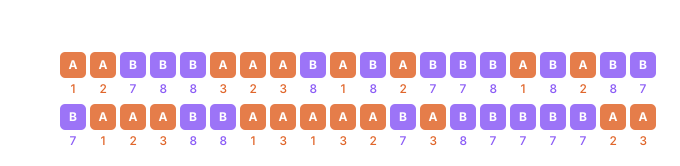
- rows where the parent chose A — the child below is always 1, 2, or 3
- rows where the parent chose B — the child below is always 7 or 8
The problem: independent fields make impossible pairs
To see why parent matters, look at what happens
without it. Two text sequences, country and city,
declared independently:
<env count="8" seed="demo">
    <sequence name="Country"><gen type="text" value="Russia,France" percent="50,50"/></sequence>
    <sequence name="City"><gen type="text" value="Moscow,Paris" percent="50,50"/></sequence>
</env>
<block><line><data>${{Country}}: ${{City}}</data></line></block>
Russia: Moscow
Russia: Moscow
France: Paris
France: Paris
Russia: Moscow
France: Paris
Russia: Paris
France: Moscow
Each field rolls its own dice. The last two rows are the problem: Russia: Paris and France: Moscow — Paris in Russia, Moscow in France. For a test that checks that the city belongs to its country, that data is garbage, and the more rows you generate, the more impossible pairs you get.
The fix: parent
Give each country its own city generator, filtered with parent="Country.Value".
Now a city is chosen only on the rows where the country matches:
<env count="8" seed="demo">
    <sequence name="Country"><gen type="text" value="Russia,France" percent="50,50"/></sequence>
    <sequence name="CityRU" parent="Country.Russia"><gen type="text" value="Moscow,Kazan"/></sequence>
    <sequence name="CityFR" parent="Country.France"><gen type="text" value="Paris,Lyon"/></sequence>
</env>
<block><line><data>${{Country}}: ${{CityRU}}${{CityFR}}</data></line></block>
Russia: Moscow
Russia: Moscow
France: Lyon
France: Lyon
Russia: Kazan
France: Paris
Russia: Kazan
France: Paris
The Country column is unchanged (same seed),
but now the city always fits: Russia gets only Moscow/Kazan, France only
Paris/Lyon. The impossible pairs are gone. On any given row exactly one of the two
city generators is active and the other is empty, so ${{CityRU}}${{CityFR}} yields a
single city.
How it works
- Declare the parent with a distribution
(
textwithpercent,template, or any type). - Declare the child with
parent="Parent.Value". - The child materializes only on rows where
Parent == Value. On every other row its value is undefined — an empty string in interpolation. - Any percentages inside the child are measured against the number of active rows — the filtered subset.
parent="Parent.Value" is answered before the
formatting layer runs, so it compares against the value
the parent's generator produced — not the one the row prints. A parent written
<gen type="text" value="alpha,beta" case="upper"/> prints ALPHA, and the child that
follows it must still say parent="Kind.alpha". Writing the printed spelling stops the
run rather than silently matching nothing: filters on parent value "Kind.ALPHA", which
the parent never produces. The same holds for mask=.
Names by gender
The classic case: men need male names, women need female names. One shared name
generator can't do it — it doesn't know the row's gender. Two name generators, each
under its own parent, can:
<env count="8" seed="demo">
    <sequence name="Gender"><gen type="text" value="Male,Female" percent="60,40"/></sequence>
    <sequence name="MaleName" parent="Gender.Male"><gen type="template" value="person.male.firstName"/></sequence>
    <sequence name="FemaleName" parent="Gender.Female"><gen type="template" value="person.female.firstName"/></sequence>
</env>
<block><line><data>${{Gender}}: ${{MaleName}}${{FemaleName}}</data></line></block>
Female: Elizabeth
Male: William
Male: James
Male: John
Male: Michael
Male: Robert
Female: Patricia
Female: Mary
Genderatcount="8"yields 5Male+ 3Female(60/40 of eight, rounded by the largest-remainder method — seepercent). Atcount="100"it would be exactly 60 + 40.MaleNameis filled only on male rows (theperson.male.firstNametemplate draws from the male dictionary); on female rows it's empty.FemaleNameworks symmetrically: it's filled only on female rows.- Concatenating
${{MaleName}}${{FemaleName}}leaves exactly one name per row, and it always matches the gender — neverMale: Patricia.
Probability within a subset
"30% of them are fans" — 30% of whom? If only Russians can be fans and you take
30% of everyone, the real share of Russian fans comes out halved. Put the
percent on the child and it applies to the filtered rows:
<env count="100" seed="demo">
    <sequence name="Country"><gen type="text" value="RU,US" percent="50,50"/></sequence>
    <sequence name="FootballFan" parent="Country.RU"><gen type="text" value="Yes,No" percent="30,70"/></sequence>
</env>
<block><line><data>${{Country}} -> [${{FootballFan}}]</data></line></block>
RU -> [Yes]
RU -> [Yes]
US -> []
RU -> [No]
RU -> [No]
US -> []
US -> []
RU -> [No]
RU -> [No]
RU -> [No]
On US rows FootballFan is empty — the generator never fires there. Counting all 100
rows, column by column:
| What | Result |
|---|---|
Country | 50 RU + 50 US |
FootballFan among RU rows | 15 Yes + 35 No |
FootballFan among US rows | 50 empty |
The 30/70 split was measured against the 50 RU rows — "30% of Russians are fans",
not "30 of all 100" (which would be 30 Yes).
Variation — a different split, same subset
Change nothing but the child's percentages, to percent="50,50":
<sequence name="FootballFan" parent="Country.RU"><gen type="text" value="Yes,No" percent="50,50"/></sequence>
FootballFan among RU rows:  25 Yes + 25 No
FootballFan among US rows:  50 empty
You now get exactly 25 Yes + 25 No among the same 50 RU rows — half of the
subset, not half of count. The US rows stay empty. This is why the percentage lives
on the child: it always scales to the parent-filtered slice.
Declaration order
A parent must be declared before its child in the document. Declare them the other way around and rendering fails immediately:
<env count="8" seed="demo">
    <sequence name="City" parent="Country.Russia"><gen type="text" value="Moscow,Kazan"/></sequence>
    <sequence name="Country"><gen type="text" value="Russia,France" percent="50,50"/></sequence>
</env>
error[TDC035]: parent sequence "Country" is not declared before this sequence
--> demo.tdc:3:35
|
3 |     <sequence name="City" parent="Country.Russia">…
|                                   ^^^^^^^^^^^^^^
|
note: Parent sequences must be declared earlier in the same <env>. Forward references and cycles are not supported.
The error names the offending line and column. Cyclic dependencies and forward references aren't supported — the dependency graph is resolved top to bottom, so parents always come first.
parent without a value
parent="Parent" — with no dot and no value — means "any row where the parent has
a value at all", regardless of which value. You rarely need it at the first level (a
top-level parent always has a value), but it's the right tool for deeper chains, where
a mid-level sequence is itself filtered and you want a grandchild only where that
mid-level one fired.
Here Country picks the US rows, USCity fills only those rows, and USZip should
appear wherever there is a US city, no matter which one — so it uses the valueless
form:
<env count="8" seed="demo">
    <sequence name="Country"><gen type="text" value="US,UK" percent="50,50"/></sequence>
    <sequence name="USCity" parent="Country.US"><gen type="text" value="New York,Chicago"/></sequence>
    <sequence name="USZip" parent="USCity"><gen type="regex" value="[0-9]{5}"/></sequence>
</env>
<block><line><data>${{Country}} | ${{USCity}} ${{USZip}}</data></line></block>
US | Chicago 78249
US | New York 90094
UK |
UK |
US | Chicago 17025
UK |
US | New York 41341
UK |
USZip fires on every US row and nowhere else — parent="USCity.New York" would have
restricted it to New York alone. The valueless form says "inherit the parent's
filter, don't add my own", which is exactly what you want for a field that hangs off
whatever the parent produced.
missing= on the parent does not stop the child"Any row where the parent has a value at all" is read as any row the parent's own
filter let through — not as "any row where the parent came out non-empty". A parent
that blanks some of its rows with missing= still counts
those rows as its own, so the child fills them:
P=[]  C=[child]
P=[b] C=[child]
P=[]  C=[child]
If the child must disappear together with the blanks, say so with a condition —
if="P" is true exactly when P produced something — rather than relying on the
valueless parent=.
Interaction with if
if expressions evaluate against the current row's
values. On a filtered-out row the child's value is undefined, which counts as empty —
and empty is false. So a condition on a child column automatically excludes the rows
where that child never fired, without an explicit parent check:
<env count="8" seed="demo">
    <sequence name="Country"><gen type="text" value="RU,US" percent="50,50"/></sequence>
    <sequence name="FootballFan" parent="Country.RU"><gen type="text" value="Yes,No" percent="30,70"/></sequence>
</env>
<block><line>
    <data>${{Country}} ${{FootballFan}}</data>
    <data if="FootballFan == Yes"> BUY</data>
</line></block>
RU Yes BUY
RU No
US
US
RU No
US
RU No
US
The BUY tag is printed only where FootballFan == Yes. US rows have an empty
FootballFan, which the comparison reads as false, so they come out without it — and you
never had to write Country == RU in the condition.
A tree in the data, not in the config
parent relates one sequence to another. A different job comes up almost as often:
a record that points at another record of the same kind. An employee whose manager is
an employee, a comment replying to a comment, a category inside a category.
That is a column, not a construct — and the whole difficulty is one word: cycles. A manager chain that loops will hang whatever renders it, and no amount of redrawing fixes it, because the problem is in the shape rather than in any one value.
The fix is arithmetic, and it needs nothing new. Point every record at a lower id than its own:
<env count="10" seed="tree" local="en">
    <sequence name="Id"><gen type="increment" value="1"/></sequence>
    <sequence name="Back"><gen type="number" value="1..4"/></sequence>
    <sequence name="ParentId"><compute><result>
        <choose>
            <when>
                <test><less_than><subtract><to_number><field name="Id"/></to_number><to_number><field name="Back"/></to_number></subtract><int v="1"/></less_than></test>
                <then>
                    <choose>
                        <when><test><equals><to_number><field name="Id"/></to_number><int v="1"/></equals></test><then><int v="0"/></then></when>
                        <otherwise><int v="1"/></otherwise>
                    </choose>
                </then>
            </when>
            <otherwise><subtract><to_number><field name="Id"/></to_number><to_number><field name="Back"/></to_number></subtract></otherwise>
        </choose>
    </result></compute></sequence>
    <sequence name="Author"><gen type="template" value="person.lastName"/></sequence>
</env>
<block>
    <line><data>${{Id}},${{ParentId}},${{Author}}</data></line>
</block>
1,0,Smith
2,1,Jones
3,1,Miller
4,1,Garcia
5,3,Davis
6,5,Williams
7,5,Brown
8,7,Johnson
9,7,Martinez
10,7,Rodriguez
Read it as id, parent_id, author. Back is how far up the tree this record attaches —
one to four rows above itself — and the two <choose> branches handle the top of the
file: record 1 gets 0, the root, and anything that would reach past it attaches to the
root instead.
What that guarantees, by construction rather than by luck:
- No cycles. Every arrow points at a smaller number, so following them always ends.
- One root. Only record 1 has no parent.
- A live shape. Record 1 has three children here and record 2 has none, because
Backis drawn per row. Widen it to1..20for a flat, wide tree; narrow it to1..2for a deep, thin one.
The same column works for an org chart, a threaded comment tree, a bill of materials, or
nested categories. What the records say is a separate question — comment text is just
text.paragraph and does not have to make conversational
sense for the tree to be a valid tree.
See also
- Sequences and
parent— the mechanics behind the filter. - Determinism & proportions — how
seedandpercentstay exact. - Coherent & relational data — parent → child by name lookup.