The <distinct> tag
Use it when two fields in the same row draw from the same pool and must not land
on the same value — two symptoms for one patient, because nobody presents with fever
and fever; a country of birth and a country of residence that shouldn't be identical.
<distinct> says one thing: its direct children must differ from each other within a
row.
This is a horizontal rule — it looks across the fields of a single row. Its
vertical twin is uniq, which keeps the whole row
from repeating anywhere in the dataset. Use either one, or both in one config on
different fields — on the same fields the combination is refused (TDC267).
The exact draws below are what a typical run produces, and they can change with the
core version and the seed. What never changes is the structure <distinct>
guarantees — no two children of a group are ever equal within a row.
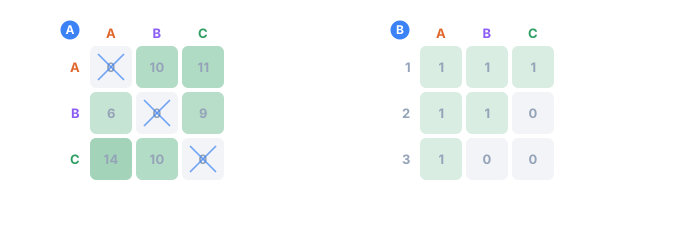
- Awith distinct, over 60 rows: the diagonal is empty, because a row can never repeat a value across its fields
- Bwith uniq, over 6 rows: no cell is ever above 1, because a combination can never repeat across rows — the empty cells are combinations this run simply never reached
The problem: two fields collide
Take two fields that read from the same list. The two
<gen> fields run independently, so sooner or later
some row draws the same word twice. Here both fields use a short four-value list,
so the collisions show up right away:
<sequence name="Case">
    <gen name="S1" type="text" value="Fever,Cough,Headache,Nausea"/>
    <gen name="S2" type="text" value="Fever,Cough,Headache,Nausea"/>
</sequence>
...
<data>${{Case.S1}}, ${{Case.S2}}</data>
Nausea, Headache
Headache, Headache
Fever, Cough
Nausea, Nausea
Headache, Fever
Cough, Nausea
Cough, Fever
Fever, Cough
Rows 2 and 4 are Headache, Headache and Nausea, Nausea — not a patient with two
complaints, but a patient with one complaint written down twice.
The fix: wrap the fields
Wrap both fields in <distinct>. Everything else stays the same — same
generators, same list, even the same seed:
<sequence name="Case">
    <distinct>
        <gen name="S1" type="text" value="Fever,Cough,Headache,Nausea"/>
        <gen name="S2" type="text" value="Fever,Cough,Headache,Nausea"/>
    </distinct>
</sequence>
Nausea, Headache
Headache, Nausea
Fever, Cough
Nausea, Cough
Headache, Fever
Cough, Nausea
Cough, Fever
Fever, Cough
The payoff. The rows that had no collision are byte-for-byte the same — the
engine left them alone. Only the two collisions were repaired: Headache, Headache
became Headache, Nausea, and Nausea, Nausea became Nausea, Cough. Only the second
field was redrawn, and only where it had to be. Order and seed are preserved.
Two levels
<distinct> works in two places, with the same rule in both: the direct children
of <distinct> produce different values in each row. All that changes is what counts
as a "child".
1. Inside a <sequence> — it wraps <gen> fields
Here <distinct> sits inside a
<sequence> and wraps the <gen name="…">
fields. Read it as "A ≠ B". This one draws from the real symptom list in the
data pack instead of a hand-written list of four:
<sequence name="Case">
    <distinct>
        <gen name="A" type="template" value="medical.symptom"/>
        <gen name="B" type="template" value="medical.symptom"/>
    </distinct>
</sequence>
Constipation + Skin Rash
Confusion + Constipation
Itching + Swelling
Sneezing + Fever
Cramping + Sneezing
Itching + Runny Nose
Why here: both fields pull from the same
template pool, yet the two values in each row always
differ. This is the everyday case — two attributes of one entity that share a source
but must not coincide. A value can still repeat down a column (Itching
shows up in rows 3 and 6): <distinct> looks across a row, never down the dataset.
2. Inside <env> — it wraps whole <sequence> blocks
At the top level, <distinct> sits inside
<env> and wraps entire <sequence>
blocks. The classic example is country of birth versus country of residence: two
independent picks from the same country list will occasionally come out identical in
one row.
<env count="100" seed="s">
    <distinct>
        <sequence name="Birth"><gen type="template" value="location.country"/></sequence>
        <sequence name="Live"><gen type="template" value="location.country"/></sequence>
    </distinct>
</env>
France      -> Bhutan
Panama      -> Chile
Montenegro  -> Japan
Cameroon    -> Kenya
Peru        -> Namibia
Guatemala   -> Grenada
Why here: the two values now live in separate sequences, so no single sequence can
compare them — the group has to sit one level up, in <env>. Within any one row, the
birth country and the country of residence never match.
How it works
The engine generates the fields as usual. If two values inside a group collide in a
row, it redraws one of them with the generator's next value, and keeps going until
they differ. Determinism is preserved: the redraws run in a fixed order, so the output
for a given seed doesn't change. It works the same in the in-memory engine and in
streaming mode — see Large outputs.
Details and gotchas
A few rules worth keeping in mind:
Values are compared, not sources
<distinct> looks at the produced string, not where it came from. If two
fields read from different files but happen to emit the same word, they still
count as a collision and one gets redrawn.
Groups are independent
You can have several <distinct> blocks, and they don't interfere with each other. A
group for the two symptoms and a separate group for, say, two phone numbers each
enforce their own rule, with no cross-talk.
<sequence name="Case">
    <distinct>
        <gen name="A" type="template" value="medical.symptom"/>
        <gen name="B" type="template" value="medical.symptom"/>
    </distinct>
    <distinct>
        <gen name="HomePhone" type="regex" value="\+1 \([0-9]{3}\) [0-9]{3}-[0-9]{4}"/>
        <gen name="CellPhone" type="regex" value="\+1 \([0-9]{3}\) [0-9]{3}-[0-9]{4}"/>
    </distinct>
</sequence>
Why: each group scopes its own constraint. The two symptoms can never equal each other, and neither can the home and cell numbers — but a symptom is free to match a phone number that happens to render the same way, because the two groups can't see each other.
Fields outside <distinct> keep no constraint
Only the direct children of a <distinct> group are constrained. Any field left
outside the group is generated normally and is free to repeat a value that one of the
distinct fields produced.
Too few values fails cleanly
If a list holds fewer distinct values than the number of fields that must differ — say
one word for two fields — the constraint is impossible to satisfy. Rather than looping
forever, TDC gives up after 1,000 attempts at a row and says so. Unlike uniq, which
proves feasibility before generating, this one trips during the run — quickly, but not
before it starts:
tdcv2: stream mode: <distinct> in sequence "Person": could not find a value
for field "B" different from the others after 1000 attempts — its source
likely has too few distinct values.
Why: an impossible request should fail loudly rather than hang. What differs from
uniq is the timing: uniq proves the whole column
feasible before generating, while <distinct> finds out on the first row it cannot
satisfy.
At the <env> level, groups take single-value sequences only
A <distinct> inside <env> can wrap only single-value sequences — a plain
<gen>, a <mix> or a <switch>. A compound
(multi-field) sequence has no single value to compare, so putting one in the group is
rejected with error TDC129:
error[TDC129]: <sequence name="Person"> inside a config-level <distinct> must produce a single value
note: A <distinct> around sequences uses one value per sequence. Use a simple
<gen> or a <switch> sequence, not a compound (multi-field) one.
Why: the horizontal rule needs one value per child to compare. Inside a sequence,
wrap the <gen> fields directly (the level-1 form above); at the <env> level, keep
each grouped sequence down to a single value.
Two references to one <pool> — compared by RECORD, not by value
A <gen type="pool"> sequence is the exception, and the case the group is most often
written for: two people drawn from the same pool who must not be the same person.
A reference holds a whole member, so there is no value to compare — the group compares which member the row took instead. Put the references in the group and no row hands two of them the same record:
<pool name="Doctors" count="6">
  <sequence name="name" uniq="true"><gen type="text" value="Adams,Brooks,Chase,Dunn,Ellis,Frost"/></sequence>
</pool>
<distinct>
  <sequence name="Duty"><gen type="pool" value="Doctors"/></sequence>
  <sequence name="Seen"><gen type="pool" value="Doctors"/></sequence>
</distinct>
on duty: Chase | seen by: Ellis
on duty: Brooks | seen by: Frost
on duty: Brooks | seen by: Chase
on duty: Dunn | seen by: Brooks
on duty: Ellis | seen by: Frost
on duty: Adams | seen by: Frost
The comparison is by identity, not by name: two members that happened to share a field would still be two different records, and the group keeps them apart on that basis.
It composes with filter=. The filter decides which members this row may have; the group
then hands each reference a different one of those. Both promises hold at once.
Three shapes are refused with TDC302, because none of them can mean anything:
- a reference beside an ordinary sequence — one holds a record and the other a string, and there is no field the comparison would be about;
- references to two different pools — a doctor is never the same record as a ward, so the group would be satisfied without doing anything;
- more references than the pool has members — no arrangement exists.
<uniq> at the <env> level works over references the same way, one axis over: no two
rows take the same combination of members. A pool of 6 offers 36 ordered pairs, so a
run longer than the pairs the draw produced is refused up front rather than quietly
repeating.
uniq keeps that promise by rearranging the picks, and an arrangement needs the whole
column — it cannot be found a row at a time. So this one shape runs on the in-memory
engine, the way a running total does; <distinct> is settled per row and streams
normally.
<distinct> vs. uniq at a glance
| Mechanism | Axis | Scope | Meaning |
|---|---|---|---|
<distinct> | horizontal | one row | fields don't equal each other within a row |
uniq | vertical | all rows | the combination of fields never repeats |
They solve different problems, and one config may use both — on different fields.
Put them on the same fields and check refuses it with TDC267: uniq rearranges the
finished columns without knowing which pairings the repair ruled out, so the repair is
undone. For the vertical rule, see Unique values.
May contain
| Tag | Where | What it holds |
|---|---|---|
<gen/> | inside <sequence> | Fields that must differ |
<sequence> | inside <env> | Sequences that must differ |
See also
- Unique values —
uniq, the vertical twin: whole rows that never repeat across the dataset. - Sequences — compound sequences and fields,
the structures
<distinct>operates on. - Determinism & proportions — why a fixed
seedreproduces the same output, redraws and all.