The http generator
Use it when the value has to come from logic TDC doesn't have — a real check-digit algorithm you already wrote, a lookup in your own database, any calculation that would be painful to express in the config. You stand up a small service, and TDC calls it: it becomes the client of your service, not the host of your code. That is the extension point — anything you can put behind an HTTP endpoint becomes part of your data.
Two modes: it generates, or it processes
One attribute decides which, and the two are genuinely different jobs:
in | what your service receives | what it does | |
|---|---|---|---|
| Source | absent | nothing but a count | invents the values itself — it acts as a generator |
| Handler | present | your values, one per line | transforms what you sent and hands it back |
Both at once, against the same service — the first column is handed over and comes back changed, the second is conjured from nothing:
<sequence name="City">
  <gen type="text" value="Paris,Berlin,Tokyo" order="sequential"/>
</sequence>

<sequence name="Handled">
  <gen type="http" src="http://127.0.0.1:5599/gen" in="City"/>   <!-- handler -->
</sequence>

<sequence name="Made">
  <gen type="http" src="http://127.0.0.1:5599/gen"/>             <!-- source -->
</sequence>
Paris  ->  [Paris ok]    |  Made: SRC-000
Berlin ->  [Berlin ok]   |  Made: SRC-001
Tokyo  ->  [Tokyo ok]    |  Made: SRC-002
The handler mode is the more useful of the two, and the one that is easy to miss. It lets a service you already have finish a value TDC started rather than replace the generator outright: validate it, add a check digit, look it up, translate it.
Your service tells the two apart by the request body: an empty body means source
mode, and the X-TDC-Count header says how many values to invent.
A complete, working service in Node, Python, and Java — covering both modes, plus how to make it reproducible from the seed — gets a page of its own: Writing a service generator.
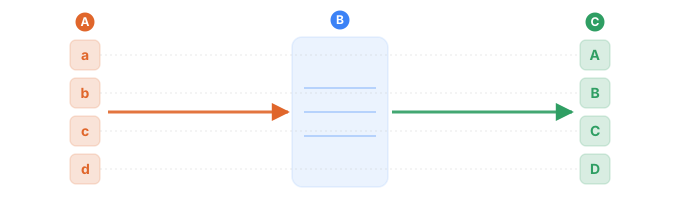
- Athe input column — the values your sequence produced
- Byour service: TDC only talks to it, never runs it
- Cthe reply — one value per row, in the order sent
Attributes
| Attribute | Meaning |
|---|---|
src | the service URL — http://127.0.0.1:5566/gen (local, fast) or a public host. https works too |
in | the sequence whose value is sent on each row — this is what turns the service into a handler. Omit it and the service is a source: it receives nothing and invents each value |
on_error | fail (default) — stop with a clear message; or empty — blank the cell and continue |
timeout | seconds to wait for one answer before giving up. Default 30 |
secret | the key each request is signed with, so your service can tell TDC from anyone else who can reach the port. Three spellings — see Proving the request came from TDC |
in names an earlier sequence — the value it produced on each row is what gets sent.
The contract your service implements
The engine speaks one small protocol and expects nothing else back:
POSTtosrc, with a headerX-TDC-Count: N— how many values are wanted.Content-Type: text/plain, exactly that, with no charset parameter. All five implementations send the same string, so a service may match it literally.- The body is the
Ninput values, one per line, in row order. With noin, the body is empty andNcomes from the header. X-TDC-Input: Ntravels wheneverinis present, and says how many input lines the body holds. It is what tells a handler from a source when the body cannot:innaming a column of one empty value sends an empty body, which is byte for byte what a source sends. A service that ignores the header reads the body exactly as it always did.X-TDC-Seedis eight hex digits derived from the run's seed and the sequence name — the same value every time, and different for every sequence, so a service that generates from it can be reproducible on its own.X-TDC-TimestampandX-TDC-Signaturetravel only when the config carriessecret.- The response must be exactly
Nlines, in the same order — line i answers input line i. Plain text.
Anything structured is your service's job. If it works with JSON internally, it returns the one field you want, as text — inside TDC every value is a string anyway.
One request per column, not per row. The engine sends the whole batch at once, so a thousand rows is one request. A service written "one line in, one line out" still works — it just loops over the lines of the one request it receives.
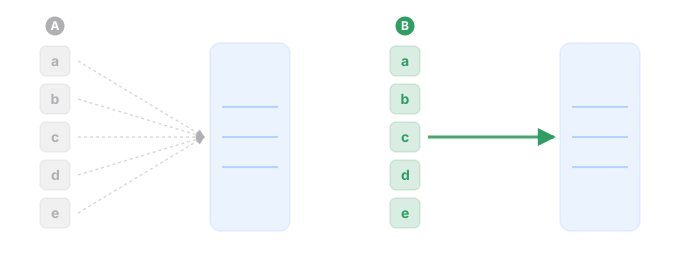
- Aone request per row — what TDC does NOT do; it would be a call per value
- Bone request for the whole column — the whole batch, one round trip
This is what keeps it fast: the cost is one round trip plus your service's own work,
not a network round trip per value. It's also why http runs on the in-memory engine
(one of six shapes that
do), and why it's best
pointed at a service on your own machine, or at a run you have sized on purpose — not a
billion rows against a distant endpoint.
A whole service, in five languages
Each of these is complete and answers both modes: it wraps whatever you send, and invents values when the body is empty. Pick your language — they behave identically.
- Node.js
- Python
- Java
- C#
- Rust
import { createServer } from 'node:http';

createServer((req, res) => {
  const chunks = [];
  req.on('data', (c) => chunks.push(c));
  req.on('end', () => {
    const count = Number(req.headers['x-tdc-count'] ?? '0');
    const sent = Buffer.concat(chunks).toString('utf8');

    const out =
      sent === ''
        ? Array.from({ length: count }, (_, i) => 'SRC-' + String(i).padStart(3, '0')) // source
        : sent.split('\n').map((line) => '[' + line + ' ok]'); // handler

    const body = out.join('\n');
    res.writeHead(200, { 'Content-Type': 'text/plain', 'Content-Length': Buffer.byteLength(body) });
    res.end(body);
  });
}).listen(5801, '127.0.0.1');
from http.server import BaseHTTPRequestHandler, HTTPServer


class H(BaseHTTPRequestHandler):
    def do_POST(self):
        n = int(self.headers.get("Content-Length", 0))
        sent = self.rfile.read(n).decode() if n else ""
        count = int(self.headers.get("X-TDC-Count", "0"))

        if sent == "":
            out = [f"SRC-{i:03d}" for i in range(count)]          # source
        else:
            out = [f"[{line} ok]" for line in sent.split("\n")]   # handler

        body = "\n".join(out).encode()
        self.send_response(200)
        self.send_header("Content-Length", str(len(body)))
        self.end_headers()
        self.wfile.write(body)


HTTPServer(("127.0.0.1", 5802), H).serve_forever()
import com.sun.net.httpserver.HttpServer;
import java.io.OutputStream;
import java.net.InetSocketAddress;
import java.nio.charset.StandardCharsets;
import java.util.ArrayList;
import java.util.List;

public class S3 {
    public static void main(String[] args) throws Exception {
        HttpServer server = HttpServer.create(new InetSocketAddress("127.0.0.1", 5803), 0);
        server.createContext("/", exchange -> {
            String sent = new String(exchange.getRequestBody().readAllBytes(),
                                     StandardCharsets.UTF_8);
            String raw = exchange.getRequestHeaders().getFirst("X-TDC-Count");
            int count = Integer.parseInt(raw == null ? "0" : raw);

            List<String> out = new ArrayList<>();
            if (sent.isEmpty()) {
                for (int i = 0; i < count; i++) out.add(String.format("SRC-%03d", i));  // source
            } else {
                for (String line : sent.split("\n", -1)) out.add("[" + line + " ok]");  // handler
            }

            byte[] body = String.join("\n", out).getBytes(StandardCharsets.UTF_8);
            exchange.sendResponseHeaders(200, body.length);
            try (OutputStream os = exchange.getResponseBody()) { os.write(body); }
        });
        server.start();
    }
}
using System.Net;
using System.Text;

var server = new HttpListener();
server.Prefixes.Add("http://127.0.0.1:5804/");
server.Start();

while (true)
{
    HttpListenerContext ctx = server.GetContext();
    using var reader = new StreamReader(ctx.Request.InputStream, Encoding.UTF8);
    string sent = reader.ReadToEnd();
    int count = int.Parse(ctx.Request.Headers["X-TDC-Count"] ?? "0");

    IEnumerable<string> lines = sent.Length == 0
        ? Enumerable.Range(0, count).Select(i => $"SRC-{i:D3}")     // source
        : sent.Split('\n').Select(line => $"[{line} ok]");          // handler

    byte[] body = Encoding.UTF8.GetBytes(string.Join("\n", lines));
    ctx.Response.ContentLength64 = body.Length;
    ctx.Response.OutputStream.Write(body);
    ctx.Response.Close();
}
use std::io::{BufRead, BufReader, Read, Write};
use std::net::TcpListener;

fn main() -> std::io::Result<()> {
    let listener = TcpListener::bind("127.0.0.1:5805")?;
    for stream in listener.incoming() {
        let mut stream = stream?;
        let mut reader = BufReader::new(stream.try_clone()?);

        let (mut length, mut count) = (0usize, 0usize);
        loop {
            let mut line = String::new();
            if reader.read_line(&mut line)? == 0 || line == "\r\n" {
                break;
            }
            let lower = line.to_ascii_lowercase();
            if let Some(v) = lower.strip_prefix("content-length:") {
                length = v.trim().parse().unwrap_or(0);
            } else if let Some(v) = lower.strip_prefix("x-tdc-count:") {
                count = v.trim().parse().unwrap_or(0);
            }
        }

        let mut sent = vec![0u8; length];
        reader.read_exact(&mut sent)?;
        let sent = String::from_utf8_lossy(&sent);

        let out: Vec<String> = if sent.is_empty() {
            (0..count).map(|i| format!("SRC-{i:03}")).collect()             // source
        } else {
            sent.split('\n').map(|line| format!("[{line} ok]")).collect()   // handler
        };

        let body = out.join("\n");
        write!(
            stream,
            "HTTP/1.1 200 OK\r\nContent-Type: text/plain\r\nContent-Length: {}\r\n\r\n{body}",
            body.len()
        )?;
    }
    Ok(())
}
No crates: the standard library has a TCP listener, and an HTTP request is a few lines of headers followed by a body.
Start one, point src at its port, and run the config from
Two modes — all five produce the same output.
The services above are the shortest thing that works. They are not reproducible: run the config twice and the invented values are whatever the service felt like.
→ Writing a service generator is the page that matters. It covers, with working code in all five languages:
- how to make a run reproducible using the
X-TDC-Seedheader TDC sends you — the one thing that gets this generator's guarantee back; - why
value(seed, i)and nevernext()— a service cannot promise call order, and an iterator quietly breaks under retries and concurrency; - the 32-bit trap that makes a naive Python port silently disagree with Node and Java;
- the pre-flight list: exact line counts, order, newlines, concurrency, batching.
Skip it and your data will look fine but won't be reproducible. That's the expensive kind of wrong.
When it goes wrong
The service is outside TDC's control, so failures are handled, not hidden:
on_error="fail"(the default) stops the run with a message naming the sequence and the service —http service for sequence "Checked" at … returned 500. A blank column in a finished file is a worse surprise than a clear stop.on_error="empty"blanks the affected column and finishes, for when a best-effort output is what you want. Checking for the gaps is then on you.429(rate limited) always stops, even underempty. "Slow down" and "stream a whole column" cannot be reconciled, and continuing would quietly truncate the data.- A service that never answers is cut off by
timeoutrather than hanging the run. - A service that floods — answering with far more than one value per line — is cut off at 64 MB with an error instead of being read into memory to the end.
- A
secretthat cannot be read — an unset variable, a missing file — stops the run before any request goes out, naming the sequence. Sending the batch unsigned instead would be the one outcome the attribute exists to prevent.
Proving the request came from TDC
A service that answers http requests is doing real work — hashing a password, minting an
account number, calling a model that costs money. If it is reachable by anything other than
your own machine, it should be able to tell TDC's requests from anyone else's.
secret= does that without ever putting the key on the wire. Each request carries a
timestamp and a signature computed from the secret; the service recomputes the same thing
with its own copy and compares.
<sequence name="Hashed">
  <gen type="http" src="https://svc.example.com/hash" in="Password"
       secret="env:TDC_HTTP_SECRET"/>
</sequence>
Two extra headers travel with the request:
X-TDC-Timestamp: 1786000000
X-TDC-Signature: hex(HMAC-SHA256(secret, timestamp \n seed \n count \n body))
Everything that decides the answer is inside the signature — change the body, the count, the seed or the minute and it no longer matches. Verifying it is a few lines:
const mine = crypto
  .createHmac('sha256', process.env.TDC_HTTP_SECRET)
  .update(`${ts}\n${seed}\n${count}\n${body}`)
  .digest('hex');
if (mine !== req.headers['x-tdc-signature']) return res.status(401).end();
All five implementations produce the same signature for the same request, so one service accepts requests from any of them.
Where the key lives
| Spelling | Where it reads from |
|---|---|
secret="env:TDC_HTTP_SECRET" | an environment variable — the recommended one |
secret="file:~/.tdc/service.key" | a file, trimmed; relative paths resolve beside the config |
secret="k7Fm2p…" | the value itself — works, and warns (TDC284) |
The literal warns rather than fails because a service on 127.0.0.1 for an afternoon is a
real use. But a config goes into version control and the key goes with it, which is why the
other two spellings exist. secret="" is an error: signing with nothing produces a
signature anyone could forge.
What signing does and does not do
- It proves the sender holds the secret, and that the request was not altered on the way.
- The timestamp is what makes a captured request useless tomorrow — how strict that
window is, is your service's decision. TDC sends its real clock, not the run's
--now, so a config pinned to a past date still works. - The secret has no expiry. A test that runs once a quarter signs correctly with a key set months ago, which is why this is a signature and not an expiring token.
- It does not hide the contents. Over plain
http://the body and reply are visible to anyone listening. If real secrets travel through the service, usehttps://as well — the two solve different problems. - The signature changes every run, because the timestamp does. That has no effect on the
data, which was never reproducible for
httpanyway.
What it does not promise
This is the one generator that trades away guarantees the rest of TDC keeps. State them to yourself before reaching for it:
- Not reproducible. The service decides the values, so
seedguarantees nothing and re-running gives different data. A config usinghttpis never treated as reproducible. - Order follows the service, not the seed.
- Local or modest volumes. Over the internet, a large run is a large number of outbound calls — this is for a service on your own machine, or a run you have sized on purpose. Not for a billion rows against a public endpoint.
- From the library, only the async path. A network call cannot come out of a
synchronous function, so
toString()andwriteFile()throw on anhttpconfig. UsetoStringAsync()/writeFileAsync()— the CLI already does. Nothing to do if you run it from the command line.
See also
- Writing a service generator — working services in Node, Python, and Java
- Generators overview
- Error codes —
TDC065–TDC069,TDC284, and the run-time failures