Unique values
Real datasets have two different "no duplicates" rules, and TDC gives you a separate tool for each:
| Mechanism | Scope | Meaning |
|---|---|---|
<distinct> | one row | fields don't equal each other within a row |
uniq | all rows | the combination of fields is unique across rows |
Think of them as the same idea on two axes. <distinct> works horizontally —
inside a single row, so you never get John John or "born in Paris, lives in Paris".
uniq works vertically — down the whole dataset, so the same
(first, last) pair never appears twice. Use either, or both in one config on
different fields. On the same fields they are refused (TDC267): uniq rearranges
the finished columns and knows nothing about which pairings the <distinct> repair
ruled out, so it would undo the repair.
The values below are what a typical run produces. Exact draws can differ by core
version and seed — what stays fixed is the structure each tool guarantees
(no in-row collisions for <distinct>, no repeated combinations for uniq).
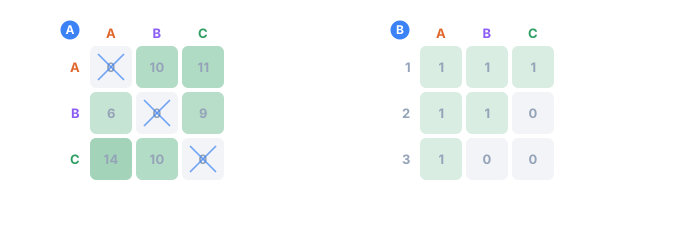
- Awith distinct, over 60 rows: the diagonal is empty, because a row can never repeat a value across its fields
- Bwith uniq, over 6 rows: no cell is ever above 1, because a combination can never repeat across rows — the empty cells are combinations this run simply didn't reach
<distinct> — different within a row
Two <gen> fields that draw from the same list
run independently, so sooner or later some row hits the same value twice. Here two
symptoms of one patient both come from a short four-item list, so the clashes show up
immediately:
<sequence name="Case">
    <gen name="S1" type="text" value="Fever,Cough,Headache,Nausea"/>
    <gen name="S2" type="text" value="Fever,Cough,Headache,Nausea"/>
</sequence>
...
<data>${{Case.S1}}, ${{Case.S2}}</data>
Nausea, Headache
Headache, Headache
Fever, Cough
Nausea, Nausea
Headache, Fever
Cough, Nausea
Cough, Fever
Fever, Cough
Rows 2 and 4 are Headache, Headache and Nausea, Nausea — not a patient with two
complaints, but a patient with one complaint written down twice.
The fix. Wrap both fields in <distinct> — everything else stays the same,
even the seed:
<sequence name="Case">
    <distinct>
        <gen name="S1" type="text" value="Fever,Cough,Headache,Nausea"/>
        <gen name="S2" type="text" value="Fever,Cough,Headache,Nausea"/>
    </distinct>
</sequence>
Nausea, Headache
Headache, Nausea
Fever, Cough
Nausea, Cough
Headache, Fever
Cough, Nausea
Cough, Fever
Fever, Cough
The rows that had no clash are byte-for-byte the same — the engine left them
alone. The two collisions were repaired: Headache, Headache became Headache, Nausea, and Nausea, Nausea became Nausea, Cough. Only the second field was redrawn, and only where
it had to be; order and seed are untouched.
Two levels
<distinct> works in two places, with the same rule at both: the direct children
of <distinct> produce different values in each row.
1. Inside a <sequence> — it wraps the
<gen name="…"> fields. Read it as "A ≠ B", here over the real symptom list from the
data pack:
<sequence name="Case">
    <distinct>
        <gen name="A" type="template" value="medical.symptom"/>
        <gen name="B" type="template" value="medical.symptom"/>
    </distinct>
</sequence>
Constipation + Skin Rash
Confusion + Constipation
Itching + Swelling
Sneezing + Fever
Cramping + Sneezing
Itching + Runny Nose
Both fields pull from the same pool, yet the two values in each row always differ.
2. Inside <env> — it wraps whole
<sequence> blocks. A classic case is "country of birth" versus "country of
residence": two independent picks from the same country list occasionally land on
the same country in one row.
<env count="100" seed="s">
    <distinct>
        <sequence name="Birth"><gen type="template" value="location.country"/></sequence>
        <sequence name="Live"><gen type="template" value="location.country"/></sequence>
    </distinct>
</env>
France      -> Bhutan
Panama      -> Chile
Montenegro  -> Japan
Cameroon    -> Kenya
Peru        -> Namibia
Guatemala   -> Grenada
Now the birth country and the residence country in a single row never match.
How it works, and the details
The engine generates the fields as usual; if two values inside a group collide in a
row, it redraws one of them with the generator's next value until they differ.
Determinism is preserved — the redraws happen in a fixed order, so the output for a
given seed doesn't change. It works the same in the in-memory engine and in
streaming.
Details worth knowing:
- Values are compared, not sources. If two fields read from different files but
happen to produce the same word,
<distinct>still redraws. - Groups are independent. A
<distinct>for first and middle names and a separate one for something else don't interfere with each other; you can have as many as you like. - Fields outside
<distinct>carry no constraint at all. - A list that's too short fails cleanly. If a list has fewer distinct values than the number of fields that must differ (say, one word for two fields), TDC raises a clear error instead of looping forever.
- At the
<env>level the group takes single-value sequences only — a plain<gen>, a<mix>or a<switch>. A compound (multi-field) sequence there is rejected with errorTDC129.
uniq — the combination never repeats
uniq="true" on a compound <sequence> means
the combination of all its fields never repeats anywhere in the dataset.
(James, Miller) and (James, Davis) are fine; two (James, Miller) rows are not.
On a simple sequence — one unnamed <gen> — uniq="true" means the value itself
never repeats: the draw runs without replacement. A weighted pack keeps its meaning
(frequent names are more likely to make the cut), but nothing appears twice. When the
source holds fewer distinct values than there are records, the run refuses up front and
names both numbers — never a quiet repeat. Supported sources: text value lists,
template packs, file columns and plain integer ranges (value="1..100000");
increment/decrement are unique by construction. A generator whose values cannot be
enumerated (regex, date, …) is refused with a message saying exactly that.
<sequence name="Person" uniq="true">
    <gen name="first" type="template" value="person.male.firstName"/>
    <gen name="last"  type="template" value="person.lastName"/>
</sequence>

<block>
    <line><data>${{Person.first}} ${{Person.last}}</data></line>
</block>
No (first, last) pair repeats. With 200 first names and 500 last names there are
up to 100,000 unique pairs; ask for more and you get an honest error up front
(see below).
Before / after, on a tiny set
Two fields with tiny sets — first ∈ {Ann, Bob} and last ∈ {Fox, Lee} — give only
4 possible pairs. Ask for 4 rows.
Without uniq (each field random on its own):
<sequence name="P">
    <gen name="first" type="text" value="Ann,Bob"/>
    <gen name="last"  type="text" value="Fox,Lee"/>
</sequence>
<block><line><data>${{P.first}} ${{P.last}}</data></line></block>
Ann Fox   2
Bob Lee   2
The combinations repeat: Ann Fox and Bob Lee each came up twice, while
Ann Lee and Bob Fox never appeared. Randomness knows nothing about uniqueness.
With uniq="true" (same config, one attribute added):
<sequence name="P" uniq="true">
    <gen name="first" type="text" value="Ann,Bob"/>
    <gen name="last"  type="text" value="Fox,Lee"/>
</sequence>
Ann Fox   1
Ann Lee   1
Bob Fox   1
Bob Lee   1
All 4 pairs, once each, no repeats.
Proportions are preserved
The engine only rearranges field values between rows; it never changes how many
of each there are. So a percent list stays exact —
uniqueness and an exact distribution can coexist. percent="70,30" still splits
70/30 even while every combination stays unique.
The feasibility check — before generation
Before rendering, TDC works out whether count unique combinations are even
possible from your data. If not, you get an error immediately, not hours in:
tdcv2: uniq "Person" is infeasible — its data supports at most 5000 distinct rows,
but 10000 were requested. Widen a column's values or lower count.
The tiny set makes the same point. Only 4 pairs exist; ask for count="5" and TDC
doesn't churn away at it — it says so right away:
tdcv2: uniq "P" is infeasible — its data supports at most 4 distinct rows,
but 5 were requested. Widen a column's values or lower count.
The maximum number of unique combinations is bounded by the product of the number of
distinct values in each field. When a field draws randomly (text
without percent), a skewed sample can shrink the usable pool. For uniq, keep a
comfortable margin (many more possible combinations than count), or set percent
for an even spread.
<uniq> — across separate sequences
When the fields live in different sequences, wrap them in <uniq>…</uniq> — the
combination of those sequences' values becomes unique across all rows:
<uniq>
    <sequence name="First"><gen type="template" value="person.male.firstName"/></sequence>
    <sequence name="Last"><gen type="template" value="person.lastName"/></sequence>
</uniq>
<block><line><data>${{First}} ${{Last}}</data></line></block>
Only single-value sequences (a plain <gen>, a
<mix> or a <switch>) can go in the group; a compound sequence can't.
A <switch> in the group cuts it into blocks
A switched value answers the subject of its own row: a male first name belongs on
a male row and nowhere else. So a group holding a <switch> is split by that
subject — male rows trade among themselves, female rows among themselves — and
the group's reach is the sum of what each block can hold, not the product of
every column.
The other members are free to move anywhere, and they are dealt across the
blocks in proportion to their sizes before anything is arranged inside them. That matters
more than it sounds. A text list is laid out in exact shares over the whole
column; the cut then hands one block whichever values happened to fall there. On
one shape the male block came out with seven of one value, three of another and
four of a third, where an even deal is five, five and four — and that was the
difference between refusing a run and rendering it.
The multiset is never touched, only distributed, so every percent= you declared
survives exactly. And nothing crosses a block: the switched column stays where it
is, and so does the subject the blocks were cut by.
How far a group reaches
A group rearranges the values it drew; it does not draw again to fit. The lists
themselves are laid out in exact shares — a plain text list always was, and a
plain pack or file list now takes the same road — and the deal that spreads a
free column across a <switch>'s blocks hands its leftover units out globally,
so no block can be starved of a value. The result is a clean edge: measured on
one shape — two subjects, three names each, five shared values — every count
up to the ceiling of 30 renders, from every seed, and every count above it is
refused. The seed decides which arrangement you get, never whether one exists.
The refusal says what the data allowed:
tdcv2: uniq: group "G × F × L" cannot produce 31 unique combinations — the values
drawn for these sequences allow at most 30 distinct rows. Add more values to a
member (more distinct names, wider ranges…) or lower the count.
The figure is the reach of the whole group — the blocks a <switch> cut it
into, added up — and it is exactly the largest count that renders. If a count is
refused, the fix is more values in a member: more distinct names, wider ranges.
This is about the uniqueness of a combination of fields, not a counter. For a
running number, use increment.
Making a joined value unique
uniq is a property of a draw. A sequence whose value is
computed, or picked per row by if=, isn't drawn from a
pool — there is nothing to take without replacement — so uniq= on it is refused
with TDC218 rather than quietly ignored.
Put uniq on the parts instead, and glue them together in the output:
<uniq>
    <sequence name="Area"><gen type="number" value="900..999"/></sequence>
    <sequence name="Group"><gen type="number" value="1..99" length="2" first_zero="true"/></sequence>
    <sequence name="Serial"><gen type="number" value="1..9999" length="4" first_zero="true"/></sequence>
</uniq>
<block><line><data>${{Area}}${{Group}}${{Serial}}</data></line></block>
Every row's (Area, Group, Serial) triple is unique, and because each part is a
fixed width — 3, 2 and 4 digits — the nine-digit string can be split back into the
triple exactly one way. A unique triple is therefore a unique string.
That last sentence is the whole trick, and it is also its limit. If a part's width
varied, two different triples could join into the same string: 9|15… and 91|5…
read alike once the boundary is gone.
Large volumes
uniq runs on disk by default, no flags — but no form of it runs on the fast streaming
engine, and which of the other two takes it depends on how you wrote it:
uniq="true"on a single drawn column — the common case — draws without replacement, which needs the pool and the values already taken. That is the in-memory engine, so memory grows withcountand the run is bounded by RAM.- A compound
uniq, auniqcounter, or an env-level<uniq>group goes to the exact on-disk engine: it lays out each column, then checks the tuples and repairs any collisions. Memory stays bounded; time does not.
Which engine runs your config
has the full routing, including the four non-uniq shapes that land in memory too.
uniq on a huge output is SLOW — uniq + percent most of allThe sort-and-repair check is thorough, and its cost grows faster than linearly with the row count. Memory stays bounded, but time doesn't — hundreds of thousands of unique rows already take minutes, and millions can run for hours or longer. That's the honest price of guaranteeing no repeat at all across a huge file.
uniq together with percent on the same columns is the worst case there is:
asking for exact proportions and no repeats at once stacks a constrained layout on top
of the sort, which is slower again by a wide margin. If a run is taking forever,
dropping either the percent or the uniq is usually what fixes it.
For uniqueness at massive scale, prefer the cheap-by-construction kinds — a
counter, or a number range
wide enough that a collision is vanishingly unlikely — and save uniq="true" over
numeric/percent columns for the sizes where the exhaustive check is worth the wait.
The mode="memory" escape hatch (the small in-RAM engine) supports every form of uniq
too — exact, but bounded by RAM. See Large outputs.
See also
- Sequences — compound sequences and fields,
the structures
uniqand<distinct>operate on. - Determinism & proportions — why
uniqrecomputes whencountchanges.