The compute sub-language
<compute> is part of the TDC language, like <switch> or <mix>, but its job is
calculation: it derives a value from other values. Inventing data at random is
<gen>'s job; <compute> processes values you already
have. It lives right in the config, inside a
<sequence>, and it's how real-world checksums get
built: a credit card's Luhn digit, an ISBN check digit, an IBAN mod-97.
<gen>produces a value (random, from a range/list/template).<compute>derives a value as a pure function of other values.
<compute> reads other sequences with <field name="…"/> — the same names you'd use
in ${{…}}, with one restriction that
interpolation does not have: the sequence has to be declared above this one. A
<field> pointing at a <sequence> further down the file is TDC182, because the row is
built in the order the config writes it.
<compute> has no randomness of its own — none at all. Give it the same inputs and
it returns the same answer, every time. A sequence whose only child is a <compute>
ignores the run's seed completely: change the seed and the column is byte-identical,
because nothing in it was ever drawn.
That is why uniq="true" is not allowed on such a sequence (TDC218).
A processor cannot promise uniqueness: it has no pool to draw from without replacement,
no columns of its own to rearrange, and no dice to re-roll on a collision — f(x) is
f(x). Whether the result repeats is a property of the formula, not of <compute>. Ask
for uniqueness on the <gen> sequences it reads, or wrap them in
<uniq>.
Every data pack that builds an identifier works this way: the <gen> siblings do the
drawing and the <compute> derives the check digit. Of the 188 bundled packs that use
<compute>, not one has a <compute> without a <gen> beside it.
A <sequence> therefore holds one or the other, never both: a <compute> next to a
<gen> is TDC219. Put the <compute> in its own
<sequence> and read the drawn one with <field name="…"/> — exactly the way the packs
are laid out.
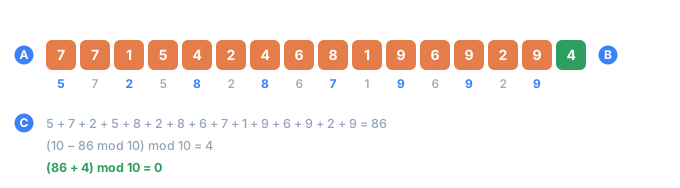
- Athe generated digits
- Bthe derived check digit
- Cthe arithmetic: every second digit is doubled, everything is summed, and the check digit is whatever brings the total to a multiple of ten
The pipe
Read a <compute> as a pipe with three parts.
- Input.
<field name="First"/>pulls in a column that already exists. - Work. Operations nest inside one another, innermost first.
- Output.
<result>holds the finished value, one per record.
A <compute> produces exactly one value. <result> is how you say which tree that value
comes from, and everything else in the block is a <let> binding or part of that tree.
When the block is a single expression you may leave <result> off — the expression is
the value. What is refused is two trees side by side, because only one of them can win.
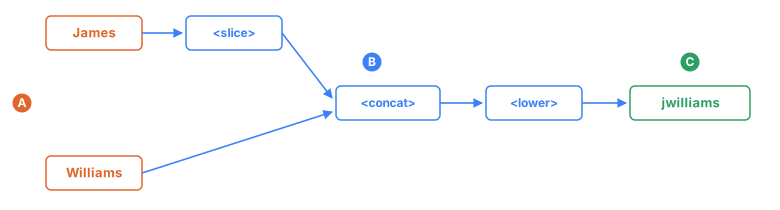
- Athe columns a <compute> reads with <field> — they were drawn elsewhere
- Bthe operations, each feeding the next; the innermost one runs first
- Cthe finished value, which is what <result> holds
Here is the whole shape at its smallest — a login built from a first name and a last name:
<tdc>
    <env count="3" seed="pipe" local="en">
        <sequence name="First"><gen type="template" value="person.male.firstName"/></sequence>
        <sequence name="Last"><gen type="template" value="person.lastName"/></sequence>
        <sequence name="Login">
            <compute>
                <result>
                    <lower>
                        <concat>
                            <slice from="0" to="1"><field name="First"/></slice>
                            <field name="Last"/>
                        </concat>
                    </lower>
                </result>
            </compute>
        </sequence>
    </env>
    <block><line><data>${{First}} ${{Last}} → ${{Login}}</data></line></block>
</tdc>
James Williams → jwilliams
Robert Johnson → rjohnson
John Smith → jsmith
Three operations, evaluated inside out: <slice> takes the first letter, <concat>
glues it to the last name, <lower> lowercases the result. Nothing here is drawn — the
two names were drawn by their <gen>s, and <compute> only rearranges what they
produced.
Slots: children with a job title
Most tags take their children as plain values, in order. Some take named roles
instead, and those children are called slots. <at> picks an element out of a list, and
it needs two different things — a list and a position — so each gets its own tag:
<tdc>
    <env count="3" seed="slot" local="en">
        <sequence name="Score"><gen type="number" value="0..2"/></sequence>
        <sequence name="Grade">
            <compute>
                <result>
                    <at>
                        <in><list v="100,200,300"/></in>
                        <index><to_number><field name="Score"/></to_number></index>
                    </at>
                </result>
            </compute>
        </sequence>
    </env>
    <block><line><data>${{Score}} → ${{Grade}}</data></line></block>
</tdc>
1 → 200
2 → 300
0 → 100
<in> and <index> are slots of <at>. They mean nothing on their own, they never
appear anywhere else, and swapping their order changes nothing — the name carries the
meaning, not the position. Fourteen of the tags on these pages are slots or loop
variables like this, and each one is introduced together with the tag that owns it.
A fuller example — a valid card number
A payment-card number is almost random: the last digit is a
Luhn check digit computed from the
rest. Generate 15 random digits, then let <compute> append the one digit that makes
the whole thing valid:
<tdc>
  <env count="100" seed="demo">
    <sequence name="Base">
      <gen type="number" length="15" first_zero="false"/>   <!-- 15 random digits -->
    </sequence>

    <sequence name="Card">
      <compute>
        <let name="sum">
          <reduce>
            <over><field name="Base"/></over>
            <init><int v="0"/></init>
            <do><add><acc/>
              <choose>
                <when>
                  <test><equals><mod><current_index/><int v="2"/></mod><int v="0"/></equals></test>
                  <then><at><in><list v="0,2,4,6,8,1,3,5,7,9"/></in>
                            <index><current/></index></at></then>
                </when>
                <otherwise><current/></otherwise>
              </choose>
            </add></do>
          </reduce>
        </let>
        <let name="check">
          <mod><subtract><int v="10"/><mod><use name="sum"/><int v="10"/></mod></subtract><int v="10"/></mod>
        </let>
        <result><concat><field name="Base"/><use name="check"/></concat></result>
      </compute>
    </sequence>
  </env>
  <block><line><data>${{Card}}</data></line></block>
</tdc>
5651468319671434
4592454318080046
6795599553235471
2342763161342247
6190038560588706
Example outputs on this page are illustrative — the exact values depend on the seed and the core version — but every line above is a genuinely Luhn-valid 16-digit number.
Piece by piece: <reduce> folds the 15 digits
into a single running sum. Every second digit (an even
<current_index/>) gets "doubled" — but Luhn wants the digit sum of the
doubled value, so instead of <multiply> the config looks it up in a small table with
<at>. A <choose> picks either
the doubled value or the plain digit. The second check step turns that sum into the
final digit, and <concat> glues it onto the base.
Three value types
Every compute expression evaluates to one of three types.
| Type | What it is | Literal |
|---|---|---|
int | a 64-bit integer | <int v="10"/> |
str | a string | <str v="AB"/> |
list | a list of int/str | <list v="2,4,10"/> |
A literal's value goes in the v attribute — in TDC, tags can't hold text between
<tag> and </tag>. There are no floats and no booleans.
Familiar names, different behavior
Several tags share a name with something in a programming language and then behave differently. A familiar name is worse than an unfamiliar one here: you do not reread the documentation for a tag you think you already know. Each row below is measured, not inferred.
| You write | You may expect | TDC gives |
|---|---|---|
<divide> of 7 by 2 | 3.5 | 3 — integer division, the remainder is dropped |
<divide> of 1 by 3 | 0.33 | 0 |
<mod> of -7 by 3 | -1, as in C, Java and JavaScript | 2 — the remainder is never negative |
<list v="a,b"/> | a list of two strings | an error: "a" is not an integer |
<replace from="[ab]"/> | a regular expression | a literal match, so nothing is replaced |
<replace from="a" to="X"/> on banana | the first a | bXnXnX — every occurrence |
<replace from="a"/> on banana, no to= | nothing, or an error | bnn — every match is deleted |
<equals> of 5 and "5" | different types, not equal | equal |
<slice from="99"> of abc | an error | an empty string, silently |
<pad width="2"> of 12345 | 12 | 12345 — width is a minimum, never a cut |
<each> used as a string | a string | an error: cannot use a list where a string is expected |
Three of these deserve more than a row.
<let> names a value once, <use> reads it back
<let name="x"> binds a name; <use name="x"/> reads it. The read tag was called <var>
until it was renamed — var is the word for a variable, and it sat on the tag that declares
nothing. A config still writing <var> is told so by name, with
TDC288.
Three rules follow, and the engine enforces all three:
| Rule | What you get when you break it |
|---|---|
| A name must be bound before it is read | TDC182: <use name="x"> is not bound by an enclosing <let> |
| A name is bound once and cannot be rebound | TDC185: <let name="x"> shadows an outer binding of the same name |
| A binding is visible only inside its own slot | a <let> inside <do> is invisible outside it — TDC182 again |
Put plainly: <let> works a value out once and gives it a name, and <use> is how the
rest of the block asks for that value again instead of repeating the work. The value
never changes after it is named — that is what makes naming it worth anything. It is the
same move as arithmetic on paper: let s be the score as a number, written once and used
to the end.
<divide> throws the remainder away
This is the one that costs the most, because nothing goes wrong loudly. A percentage
computed as <divide> of a part by a whole is 0 for every record, and the column looks
plausible until someone checks it. Multiply first and divide last, or keep the value in
whole units — cents rather than dollars.
Dividing by zero is refused rather than silently skipped:
<divide>: the divisor (second child) must not be zero.
A value from a <field> is a string
<field name="Score"/> hands you a string even when the column holds digits. Arithmetic
needs a number, so <to_number> sits on the border between the two. Miss it and the
error names the tag that received the wrong type.
The reverse crossing is automatic: a number placed in <concat> becomes its digits.
Two names are the exception, because they are counts rather than data: _count and
_total arrive as numbers. They go straight into <mod> or <add> with no
<to_number> — and, for the same reason, <is_digit> and <encode> will not take them,
since both expect a single character of text. check refuses that pairing with
TDC286 rather than leaving it to the run: <is_digit> used to
answer "no" on every row, including the rows where the count is a single digit, and
<encode> used to stop mid-run naming no file and no line.
The tag families
Each family has its own page with worked examples; the full alphabetical catalog is in the Compute functions reference.
Literals & references
The values you start from and the names you give intermediate results.
| Tag | What it does |
|---|---|
<int v="10"/> | an integer (v is decimal, may carry a leading -) |
<str v="AB"/> | a string |
<list v="2,4,10"/> | a comma-separated list of ints |
<field name="X"/> | the value of sequence X in scope — same as ${{X}} |
<use name="X"/> | the value bound by an enclosing <let name="X"> |
<let name="X">… | names an intermediate result that sibling tags can read |
<current/> | the current element (only inside <do>) |
<current_index/> | the zero-based position of the current element |
<acc/> | the accumulator (only inside <reduce><do>) |
Arithmetic
Integer math. <add> sums its children, <subtract> is first-minus-the-rest,
<multiply> is the product, <divide> is integer division, and <mod> is an
always-non-negative remainder. Alongside them are <to_number> (a digit string →
int) and <encode> (a character → a number in some base).
Lists & iteration
<each> maps <do> over a list, <reduce> folds a list down to one value through
<acc>, <join> renders a list as a string, <at> pulls one element out by position,
and <length> measures a string or a list. The wrappers <over> / <do> / <init> /
<in> / <index> mark exactly which child plays which role.
Strings & formatting
<concat> glues parts together; <upper> / <lower> / <capitalize> / <title>
change case; and <mask>, <slice>, <replace>, <trim>, <group>, and <pad>
reshape a string. You can get the same formatting through
<gen> attributes and ${{X|…}} filters.
Conditionals
<choose> takes the first <when> whose <test> is true, and falls back to
<otherwise>, which is required. Predicates live only inside <test> and return no
value: <equals>, <greater_than>, and <less_than> compare two ints, and
<is_digit> asks whether a character is 0–9.
<choose>
  <when><test><greater_than><use name="d"/><int v="9"/></greater_than></test>
        <then><subtract><use name="d"/><int v="9"/></subtract></then></when>
  <otherwise><use name="d"/></otherwise>
</choose>
In packs: parameters and <valid>
The built-in identifier generators are .tdc packs where <compute> sits next to
<gen>. Two mechanisms exist to help pack authors.
Parameters
Any attribute on the calling <gen type="template" …> — other than the reserved
type / value / local — replaces a same-named local <sequence> in the pack
with a constant. The pack author declares the parameter as a sequence with a default,
and the caller can pin it:
<gen type="template" value="usa.docs.ssn" area="078"/>
Every number now starts with the fixed area code (area), and the pack's own rules
still apply to the rest — the group and serial are drawn as usual.
078772009
078599501
078844442
Use it when one preset has to cover many concrete variants — a single SSN pack that any area code can drive, or one phone pack you aim at a specific area code.
Reject-and-retry — <valid>
Sometimes a computed check digit can't be represented in the target format. An ISBN-10
check value of 10 is written as the letter X, so if a field has to stay purely
numeric, those rows have to be thrown out. A pack adds one <valid> predicate and the
engine regenerates the base until it passes — with a safety cap, so an impossible
condition can't loop forever:
<sequence name="check"><compute><result> …check digit… </result></compute></sequence>
<valid><less_than><to_number><field name="check"/></to_number><int v="10"/></less_than></valid>
Across thousands of rows, not one will have a check value of 10 — every ISBN-10 emitted by this config is ten clean digits.
The bundled common.book.isbn10 deliberately does the opposite: it carries no <valid>
and writes the X, because that is what a real ISBN-10 does. About one in ten ends in
X — measured, 30 of 300. Add the predicate above when a column has to stay numeric;
leave it off when you want the standard.
4188261811
8761685496
2444206142
Use it when a correct value can still be invalid for the domain — an unissued range, a forbidden check digit — and you want the pack to emit nothing but good rows.
Limitations
- No expression strings — every operation is its own tag.
- Integers only — a 64-bit overflow is an error, not a silent wrap; there are no floats or booleans.
- Bounded loops only (
<each>,<reduce>over a finite input) — the language always terminates. - Tag names use
_(likebefore_block):current_index,to_number,greater_than,less_than,is_digit. - Tree errors are caught before the run (codes
TDC180–TDC187): an unknown tag, an unbound<use>, a<choose>with no<otherwise>, and so on.
See also
- Compute functions reference — the full catalog.
- Conditionals —
<choose>, predicates, and<valid>in depth. - Masks & case — the same formatting via filters and
<gen>attributes.