Conditionals
Checksum algorithms branch — "if the doubled digit is over 9, subtract 9" (Luhn), "if
the remainder is 10, use 0" (mod-11). Bucketing branches too — "under 30 is low, under
80 is mid, otherwise high". <compute> expresses every one of these
with a single conditional tag, <choose>, and a handful of yes/no predicates.
<choose> is the same conditional idea as the top-level <switch> tag, but where
<switch> is a plain key-to-value lookup table, <choose> computes a value inside
<compute> and can test any condition — a comparison, a remainder, "is this a digit" —
not just whether a key matched.
The shape
| Tag | What it does |
|---|---|
<choose> | the first <when> whose <test> is true; else <otherwise> |
<when> | one branch: a <test> predicate and a <then> value |
<test> | holds exactly one predicate, yields yes/no |
<then> | the value returned when this branch's <test> is true |
<otherwise> | the "else" branch — required |
Predicates live only inside <test> and return yes/no (never a value):
| Predicate | True when |
|---|---|
<equals> | two integers are equal |
<greater_than> | A > B (strict) |
<less_than> | A < B (strict) |
<is_digit> | a character is a digit 0–9 |
There's no standalone boolean type in the language: a yes/no answer exists only for the
duration of a <test>. The value of a branch always comes from <then> or
<otherwise>.
<choose> — pick the first matching branch
Takes one or more <when> branches plus one <otherwise> → gives the value of the first branch whose test holds. Branches are tried in document order, so order is a decision, not a formality.
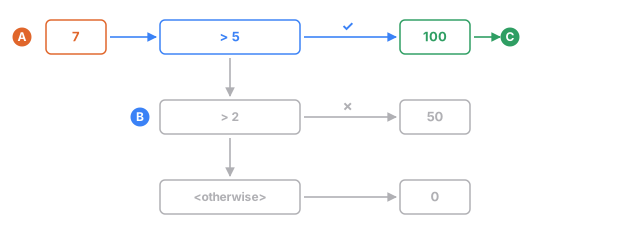
- Athe value the branches are asked about
- Bthe tests, tried in the order they are written
- Cthe value of the first branch that held — the faint ones are never reached
<choose> walks its <when> children top to bottom and returns the <then> of the
first one whose <test> is true. If none match, it returns <otherwise>. First match
wins, so the order of branches matters, and <otherwise> is mandatory — a <choose>
must always be able to produce a value.
<choose> takes no attributes; everything is expressed through its <when> branches
and the required <otherwise>.
Example — the Luhn "subtract 9"
The classic Luhn step: double each digit, and if the result is over 9, subtract 9. Here
<each> walks the digits, <current/> is the digit being
processed, and <choose> decides whether the subtraction applies.
<sequence name="Num"><gen type="number" value="100000..999999"/></sequence>
<sequence name="Doubled">
  <compute>
    <result>
      <join sep=" ">
        <each>
          <over><field name="Num"/></over>
          <do>
            <let name="x"><multiply><current/><int v="2"/></multiply></let>
            <choose>
              <when>
                <test><greater_than><use name="x"/><int v="9"/></greater_than></test>
                <then><subtract><use name="x"/><int v="9"/></subtract></then>
              </when>
              <otherwise><use name="x"/></otherwise>
            </choose>
          </do>
        </each>
      </join>
    </result>
  </compute>
</sequence>
692481 -> 3 9 4 8 7 2
730544 -> 5 6 0 1 8 8
815209 -> 7 2 1 4 0 9
428170 -> 8 4 7 2 5 0
903622 -> 9 0 6 3 4 4
Example outputs on this page are illustrative — the exact values depend on the seed and
the core version. For 692481: 6*2=12 is over 9, so 12-9=3; 2*2=4 isn't, so it
stays 4; and so on. The <otherwise> branch handles the ordinary case, where the
<test> didn't fire.
Example — ranges (branch order matters)
Several <when> branches in a row read like an "if … else if …" ladder. Because the
first match wins, you write the thresholds in ascending order so each branch only has to
rule out the ones above it. The sequence's value is a string, so it's wrapped once in
<to_number> with <let> and compared as an integer.
<sequence name="Score"><gen type="number" value="0..100"/></sequence>
<sequence name="Grade">
  <compute>
    <let name="s"><to_number><field name="Score"/></to_number></let>
    <result>
      <choose>
        <when>
          <test><less_than><use name="s"/><int v="30"/></less_than></test>
          <then><str v="low"/></then>
        </when>
        <when>
          <test><less_than><use name="s"/><int v="80"/></less_than></test>
          <then><str v="mid"/></then>
        </when>
        <otherwise><str v="high"/></otherwise>
      </choose>
    </result>
  </compute>
</sequence>
96  -> high
25  -> low
58  -> mid
34  -> mid
7   -> low
25 is under 30, so it takes low. 34 isn't under 30 but is under 80, so the second
branch wins with mid. 96 clears every threshold, so <otherwise> fires with high.
<otherwise> is required — error TDC184
One <otherwise> closes the whole <choose>, not each <when>. It is the single tail
that runs when no branch matched, and leaving it out is an error rather than an empty
result — a config that silently produced nothing for the rows nobody thought about is
exactly the failure this refuses to allow.
Drop the <otherwise> and the config won't load. The engine can't prove that some branch
will always match, and a <choose> has to yield a value no matter what, so it rejects
the tree before the run:
<choose>
  <when>
    <test><greater_than><to_number><field name="D"/></to_number><int v="5"/></greater_than></test>
    <then><str v="big"/></then>
  </when>
</choose>
error[TDC184]: <choose> requires an <otherwise> branch
Add an <otherwise> with a fallback value and it loads. This is one of the compile-time
tree checks (TDC180–TDC187) that catch structural mistakes before any data is
generated.
<when> — one branch
Takes the slots <test> (the condition) and <then> (the value) → gives nothing on its own. A <when> exists only inside a <choose>, and it needs both slots.
A <when> is a single branch of a <choose>: a condition paired with a value. It has
exactly two children — <test> (the condition) and <then> (the value to return when
the condition holds). Both are required; omitting either is error TDC187. A <choose>
can hold as many <when> branches as you like, and they are checked in order.
You never write a <when> on its own — it always sits inside a <choose>, alongside
its siblings and the required <otherwise>.
Example — a digit-sum threshold
One branch: "if the digit sum is over 18, high, otherwise low". A
<reduce> adds the digits, and the single <when> inside <choose> picks
the answer.
<sequence name="Pin"><gen type="number" value="1000..9999"/></sequence>
<sequence name="Sum">
  <compute>
    <result>
      <reduce>
        <over><field name="Pin"/></over>
        <init><int v="0"/></init>
        <do><add><acc/><current/></add></do>
      </reduce>
    </result>
  </compute>
</sequence>
<sequence name="Bucket">
  <compute>
    <result>
      <choose>
        <when>
          <test><greater_than><to_number><field name="Sum"/></to_number><int v="18"/></greater_than></test>
          <then><str v="high"/></then>
        </when>
        <otherwise><str v="low"/></otherwise>
      </choose>
    </result>
  </compute>
</sequence>
3115  sum=10  -> low
9917  sum=26  -> high
5120  sum=8   -> low
5815  sum=19  -> high
9444  sum=21  -> high
The <test> checks sum > 18 and <then> returns high. When the sum is 18 or less
(10, 8), the <when> doesn't fire and <otherwise> answers low.
<test> — the condition slot
Takes one predicate → gives true or false to the <when> around it. There are no booleans as values in the language: a predicate can appear here and nowhere else.
A <test> is the "condition slot" of a <when>. It holds exactly one predicate and
turns it into the yes/no that <choose> uses to decide whether to take the branch. It
doesn't compute a number or a string — it marks the part of a <when> where the
condition lives (the other part being <then>, the value). A <test> comes first,
before <then>, and is required inside a <when> (otherwise TDC187).
Predicates work only inside a <test> — anywhere else they're invalid, because they
produce a yes/no rather than a value.
Example — parity via remainder
Here <test> holds an <equals> predicate: "the
remainder after dividing by 2 is 0". If so, the number is even.
<sequence name="N"><gen type="number" value="1000..9999"/></sequence>
<sequence name="Parity">
  <compute>
    <result>
      <choose>
        <when>
          <test>
            <equals>
              <mod><to_number><field name="N"/></to_number><int v="2"/></mod>
              <int v="0"/>
            </equals>
          </test>
          <then><str v="even"/></then>
        </when>
        <otherwise><str v="odd"/></otherwise>
      </choose>
    </result>
  </compute>
</sequence>
8452  -> even
9083  -> odd
4216  -> even
5734  -> even
3005  -> odd
Inside the <test> sits one predicate, <equals>. It compares the
<mod> remainder against zero and yields yes/no; 3005 is odd
(remainder 1), so <otherwise> fires.
The wrapper slots (<test>, <then>, and the iteration wrappers <over> / <do> /
<init> / <in> / <index>) exist so that a tag with several parts can name each part
explicitly instead of inferring it from child order.
The predicates
Every predicate returns yes/no and is valid only inside a <test> (or a <valid>,
below). All four take integer operands, and a single character is accepted wherever its
digit value is what's meant.
<equals> — two integers are equal
Takes two values → gives true or false. Comparison is loose across types: 5 and "5" are equal.
True when its two children evaluate to the same integer. This is the building block for "is the remainder zero", "did the check digit match", and "is this exactly N".
<sequence name="V"><gen type="number" value="1..1000"/></sequence>
<sequence name="Kind">
  <compute>
    <result>
      <choose>
        <when>
          <test><equals><mod><to_number><field name="V"/></to_number><int v="10"/></mod><int v="0"/></equals></test>
          <then><str v="round"/></then>
        </when>
        <otherwise><str v="other"/></otherwise>
      </choose>
    </result>
  </compute>
</sequence>
40   -> round
417  -> other
250  -> round
83   -> other
900  -> round
Use it when a value must match a target exactly — a matched checksum, an exact bucket key, a multiple of some base.
<greater_than> — strict A > B
Takes two numbers → gives true or false. Strict: equal values are false.
True when the first child is strictly greater than the second (A > B, not >=). This
is the Luhn "over 9" test, and any "above a threshold" branch.
<sequence name="M"><gen type="number" value="1..1000"/></sequence>
<sequence name="Level">
  <compute>
    <result>
      <choose>
        <when>
          <test><greater_than><to_number><field name="M"/></to_number><int v="500"/></greater_than></test>
          <then><str v="high"/></then>
        </when>
        <otherwise><str v="low"/></otherwise>
      </choose>
    </result>
  </compute>
</sequence>
742  -> high
318  -> low
906  -> high
88   -> low
651  -> high
Use it when a branch fires above a cutoff. Because it's strict, the cutoff value
itself falls through to the next branch — choose > or < deliberately at the
boundaries.
<less_than> — strict A < B
Takes two numbers → gives true or false. Strict: equal values are false.
True when the first child is strictly less than the second (A < B). It's the natural
way to write ascending threshold ladders, and it's the guard used by the mod-11
<valid> check below.
<sequence name="K"><gen type="number" value="0..99"/></sequence>
<sequence name="Width">
  <compute>
    <result>
      <choose>
        <when>
          <test><less_than><to_number><field name="K"/></to_number><int v="10"/></less_than></test>
          <then><str v="single"/></then>
        </when>
        <otherwise><str v="double"/></otherwise>
      </choose>
    </result>
  </compute>
</sequence>
7   -> single
42  -> double
3   -> single
88  -> double
15  -> double
Use it when a branch fires below a cutoff, or you're building a low → high ladder
of ranges (see the grade example above).
<is_digit> — a character is 0–9
Takes one single-character string → gives true or false. A longer string is false, so "12" does not pass.
True when its single-character argument is a decimal digit. Useful when classifying the
characters of a mixed alphanumeric code. Here <slice> takes the first
character and <is_digit> tests it.
<sequence name="Code"><gen type="regex" value="[A-Z0-9]{5}"/></sequence>
<sequence name="First">
  <compute>
    <result>
      <choose>
        <when>
          <test><is_digit><slice from="0" to="1"><field name="Code"/></slice></is_digit></test>
          <then><str v="numeric-first"/></then>
        </when>
        <otherwise><str v="alpha-first"/></otherwise>
      </choose>
    </result>
  </compute>
</sequence>
7F2QK  -> numeric-first
KP83M  -> alpha-first
90ZTR  -> numeric-first
BQ4L1  -> alpha-first
5MHW2  -> numeric-first
Use it when a rule depends on whether a character is a digit — validating a leading symbol, splitting letters from numbers, gating a per-character branch.
<valid> — reject-and-retry
<valid> is a reject-and-retry check used in generator packs.
It holds one predicate; after a pack has produced its base values, the engine checks
the predicate and, if it's false, regenerates the base and tries again — repeating
until the result passes (with a safety cap so an impossible condition fails cleanly
instead of looping forever). The predicates are the same four as in <choose>.
Unlike <choose>, <valid> is written next to the pack's generators and its
<data> output, not inside a <compute>. It's part of pack mechanics, so it doesn't
show up in an ordinary config — there, you derive the value with a formula and never
redraw.
<valid> takes no attributes; the condition is its single predicate child.
Example — keep only even numbers
A small self-contained pack: generate a number in 10..99, compute its remainder mod 2,
and use <valid> to reject the odd ones. Only evens reach the output.
---
address: common.demo.even_only
description: demo — only even numbers (reject odd via <valid>)
generator: tdc
---
<sequence name="base"><gen type="number" value="10..99"/></sequence>
<sequence name="rest"><compute><result>
  <mod><to_number><field name="base"/></to_number><int v="2"/></mod>
</result></compute></sequence>
<valid><equals><field name="rest"/><int v="0"/></equals></valid>
<data>${{base}}</data>
Called as <gen type="template" value="common.demo.even_only"/>:
84
90
42
26
30
46
90
46
The 10..99 range yields both even and odd numbers, but <valid> passes only the rows
where rest == 0. No odd number appears — the engine redrew the base until an even one
came up.
Example — an ISBN-10 whose check digit stays numeric
An ISBN-10 check value of 10 is normally written as the letter X. If a field must stay
purely numeric, those rows have to be thrown out. This pack computes the weighted mod-11
check and requires it to be under 10; anything else is regenerated. This is the same
guarantee the built-in ISBN packs give.
<sequence name="base"><gen type="regex" value="[0-9]{9}"/></sequence>
<sequence name="check"><compute><result>
  <mod>
    <subtract>
      <int v="11"/>
      <mod>
        <reduce>
          <over><field name="base"/></over>
          <init><int v="0"/></init>
          <do><add><acc/><multiply><current/>
            <at><in><list v="10,9,8,7,6,5,4,3,2"/></in><index><current_index/></index></at>
          </multiply></add></do>
        </reduce>
        <int v="11"/>
      </mod>
    </subtract>
    <int v="11"/>
  </mod>
</result></compute></sequence>
<valid><less_than><to_number><field name="check"/></to_number><int v="10"/></less_than></valid>
<data>${{base}}${{check}}</data>
4188261811
8761685496
2444206142
8745782784
0357781341
Every emitted value is ten clean digits: across thousands of rows not one has a check
value of 10, because <valid> rejects those bases and draws again.
Use it when a correct value can still be invalid for the domain — a forbidden check digit, an unissued range — and you want the pack to guarantee only good rows without complicating the formula.
Errors and limits
TDC184— a<choose>with no<otherwise>. Every<choose>must be able to return a value, so the missing "else" is caught before the run.TDC187— a<when>missing its<test>or<then>(or a wrapper slot left empty). Each branch needs both a condition and a value.- Predicates are valid only inside a
<test>or a<valid>; there is no boolean value elsewhere in the language. - Comparisons are on integers — a numeric string is converted with
<to_number>first (as in the grade and parity examples). There are no floats. <greater_than>and<less_than>are strict: the boundary value itself falls through to the next branch. Choose the operator with the boundary in mind.
See also
- Compute overview — where conditionals fit in a full checksum.
- Arithmetic — the
<mod>,<subtract>, and<to_number>used in the tests above. - Lists & iteration —
<each>and<reduce>, the loops a per-digit<choose>runs inside. - Compute functions reference — the full tag catalog.