Arithmetic
Integer math inside <compute>. Every operation is its own tag; nest
them to build an expression tree. These are the arithmetic operators of the TDC
language — they live in a <sequence> right next to
<gen>, both in your own config and inside the built-in
identifier packs.
| Tag | What it does | Example → result |
|---|---|---|
<add> | sum of all children (empty → 0) | add(2, 3, 4) → 9 |
<subtract> | first minus the sum of the rest | subtract(10, 3, 2) → 5 |
<multiply> | product of all children (empty → 1) | multiply(2, 3, 4) → 24 |
<divide> | integer division toward −∞ (exactly 2 children) | divide(7, 2) → 3 |
<mod> | remainder, always ≥ 0 (exactly 2 children) | mod(17, 5) → 2 |
Two rules hold for all of them:
- Integers only. A single-digit string (
"7") is coerced automatically, but a multi-digit string like a sequence value ("342") is not — wrap it in<to_number>first. This is deliberate: it keeps "add two values as numbers" from being confused with "glue two strings together" (<concat>). - Overflow is an error. A 64-bit overflow is reported, not silently wrapped, so you find out about it before bad data ships.
Example outputs on this page are illustrative: the exact values depend on the seed and the core version, but the arithmetic shown is always correct.
<add>
Takes any number of children → gives a number. No children gives 0. A single-digit string coerces on its own; a multi-digit one needs <to_number> first.
<add> sums all of its children in order and returns an integer. With no children
it returns 0 (the additive identity). Use it when you need a derived total — an
order sum, a total score — or a running accumulator inside a fold.
Sum of two fields
Sequence values are strings, so each field is wrapped in <to_number>:
<sequence name="Base"><gen type="number" value="100..900"/></sequence>
<sequence name="Tax"><gen type="number" value="10..90"/></sequence>
<sequence name="Total">
  <compute>
    <result>
      <add>
        <to_number><field name="Base"/></to_number>
        <to_number><field name="Tax"/></to_number>
      </add>
    </result>
  </compute>
</sequence>
742 + 55 = 797
318 + 61 = 379
560 + 24 = 584
193 + 88 = 281
607 + 39 = 646
Digit sum inside a fold
Inside <reduce>, <add> accumulates a result:
<current/> is the next digit (a one-character string, so it coerces on
its own) and <acc/> is the running total. No <to_number> is needed
here, because each element is a single digit.
<sequence name="Pin"><gen type="number" value="1000..9999"/></sequence>
<sequence name="DigitSum">
  <compute>
    <result>
      <reduce>
        <over><field name="Pin"/></over>
        <init><int v="0"/></init>
        <do><add><acc/><current/></add></do>
      </reduce>
    </result>
  </compute>
</sequence>
4821 -> sum 15
3067 -> sum 16
9145 -> sum 19
5530 -> sum 13
7284 -> sum 21
4+8+2+1 = 15, 3+0+6+7 = 16, and so on. This weighted-then-summed shape is the core
of every check-digit scheme (see <mod>).
<subtract>
Takes any number of children → gives a number: the first minus the sum of the rest.
<subtract> takes the first child and subtracts the sum of all the rest,
returning an integer. It needs at least one child (otherwise error TDC183); with
a single child it returns that value unchanged (subtract(9) → 9). Use it when
you need a difference — a balance, change due, seats remaining, or age as "current year
minus birth year".
Account balance
<sequence name="Deposit"><gen type="number" value="500..900"/></sequence>
<sequence name="Withdrawal"><gen type="number" value="100..400"/></sequence>
<sequence name="Balance">
  <compute><result>
    <subtract>
      <to_number><field name="Deposit"/></to_number>
      <to_number><field name="Withdrawal"/></to_number>
    </subtract>
  </result></compute>
</sequence>
830 - 245 = 585
655 - 190 = 465
719 - 302 = 417
588 - 137 = 451
742 - 168 = 574
First minus the sum of the rest
With three children <subtract> takes the first minus the sum of the other two —
used when several items draw down one budget:
<sequence name="A"><gen type="number" value="10..40"/></sequence>
<sequence name="B"><gen type="number" value="10..40"/></sequence>
<sequence name="Left">
  <compute><result>
    <subtract>
      <int v="100"/>
      <to_number><field name="A"/></to_number>
      <to_number><field name="B"/></to_number>
    </subtract>
  </result></compute>
</sequence>
100 - 22 - 31 = 47
100 - 15 - 28 = 57
100 - 34 - 19 = 47
100 - 27 - 27 = 46
100 - 11 - 40 = 49
100 − (22 + 31) = 47 — what gets subtracted is the sum of everything after the
first child. The 11 − remainder step in many check-digit schemes is written as
<subtract> paired with <mod>.
<multiply>
Takes any number of children → gives a number. No children gives 1.
<multiply> multiplies all of its children in order and returns an integer. With
no children it returns 1 (the multiplicative identity). Use it when you need
a derived product — area, volume, "price × quantity" — or, most often, to weight a
digit by its position when computing a check digit.
Area
<sequence name="W"><gen type="number" value="2..9"/></sequence>
<sequence name="H"><gen type="number" value="2..9"/></sequence>
<sequence name="Area">
  <compute><result>
    <multiply>
      <to_number><field name="W"/></to_number>
      <to_number><field name="H"/></to_number>
    </multiply>
  </result></compute>
</sequence>
6 x 7 = 42
3 x 9 = 27
8 x 4 = 32
5 x 5 = 25
2 x 8 = 16
Weighted digit sum inside a fold
The classic use for <multiply> is weighting each digit by its position when computing
a check digit (Luhn, ISBN, IBAN). Inside <reduce>, each digit —
<current/>, a one-character string that coerces on its own — is
multiplied by a weight pulled from a list by position with <at> and
<current_index/>:
<sequence name="Base"><gen type="number" value="100000000..999999999"/></sequence>
<sequence name="Weighted">
  <compute><result>
    <reduce>
      <over><field name="Base"/></over>
      <init><int v="0"/></init>
      <do>
        <add>
          <acc/>
          <multiply>
            <current/>
            <at><in><list v="1,3,1,3,1,3,1,3,1"/></in>
                <index><current_index/></index></at>
          </multiply>
        </add>
      </do>
    </reduce>
  </result></compute>
</sequence>
384019267 -> weighted 86
512700483 -> weighted 62
907316258 -> weighted 69
146829035 -> weighted 86
673540192 -> weighted 79
Each digit is multiplied by its weight (1,3,1,3,…) and <add> accumulates
the sum of the products. That weighted sum is then usually taken <mod> some
base, and that's exactly how a check digit is produced.
<divide>
Takes exactly two children → gives a whole number. The remainder is dropped, so 7 divided by 2 is 3 and 1 divided by 3 is 0. A zero divisor is refused.
<divide> divides the first child by the second and returns an integer — the
fractional part is dropped. It takes exactly two children (otherwise error
TDC183), and dividing by 0 is an error. Use it when you split a quantity into
equal parts (price per unit, average per head, cents → dollars with ÷ 100), or to
peel digits off a number alongside <mod>.
How much each
<sequence name="Total"><gen type="number" value="100..900"/></sequence>
<sequence name="Count"><gen type="number" value="3..7"/></sequence>
<sequence name="Per">
  <compute><result>
    <divide>
      <to_number><field name="Total"/></to_number>
      <to_number><field name="Count"/></to_number>
    </divide>
  </result></compute>
</sequence>
645 / 5 = 129
480 / 3 = 160
733 / 6 = 122
218 / 4 = 54
591 / 7 = 84
218 ÷ 4 = 54 — the remainder (2) is dropped. If it's the remainder you want, use
<mod>.
Rounding is toward −∞
One detail worth knowing: division rounds down (floor), not toward zero. With
positive operands that's the familiar result (7 ÷ 2 = 3); with negative ones it goes
lower:
<sequence name="D1"><compute><result><divide><int v="-7"/><int v="2"/></divide></result></compute></sequence>
<sequence name="D2"><compute><result><divide><int v="7"/><int v="2"/></divide></result></compute></sequence>
<sequence name="D3"><compute><result><divide><int v="-8"/><int v="4"/></divide></result></compute></sequence>
<sequence name="D4"><compute><result><divide><int v="-1"/><int v="2"/></divide></result></compute></sequence>
-7/2=-4 7/2=3 -8/4=-2 -1/2=-1
−7 ÷ 2 gives −4 (rounded down), and −1 ÷ 2 gives −1. An exact division like
−8 ÷ 4 stays −2. <divide> and <mod> are a matched pair, which is what
checksum algorithms expect.
<mod>
Takes exactly two children → gives a number in 0 … |divisor|-1. Never negative, unlike % in C, Java or JavaScript — <mod>7, -5</mod> is 2.
<mod> returns the remainder of the first child divided by the second — an
integer, always non-negative. It takes exactly two children (otherwise error
TDC183), and dividing by 0 is an error. The remainder is Euclidean: always in
[0, |divisor|), so it is never negative even when the dividend is
(−3 mod 5 = 2, not −3). This differs from % in some languages, where the
remainder carries the sign of the dividend.
Use it when you compute a check digit (the heart of every validation scheme), split a number into digits, or wrap an index into a list's bounds.
Last digit and parity
n mod 10 extracts the last digit; n mod 2 tells you even or odd (0 is even, 1 is
odd):
<sequence name="N"><gen type="number" value="1000..9999"/></sequence>
<sequence name="Last">
  <compute><result><mod><to_number><field name="N"/></to_number><int v="10"/></mod></result></compute>
</sequence>
<sequence name="Parity">
  <compute><result><mod><to_number><field name="N"/></to_number><int v="2"/></mod></result></compute>
</sequence>
4827: last=7, parity=1
9060: last=0, parity=0
3514: last=4, parity=0
6288: last=8, parity=0
7135: last=5, parity=1
The remainder is always ≥ 0
With negative dividends you can see that <mod> is Euclidean — the result never goes
negative:
<sequence name="M1"><compute><result><mod><int v="-3"/><int v="5"/></mod></result></compute></sequence>
<sequence name="M2"><compute><result><mod><int v="3"/><int v="5"/></mod></result></compute></sequence>
<sequence name="M3"><compute><result><mod><int v="-13"/><int v="10"/></mod></result></compute></sequence>
-3 mod 5=2 3 mod 5=3 -13 mod 10=7
−3 mod 5 gives 2 (because −3 = −1·5 + 2) and −13 mod 10 gives 7. The result
always lands in [0, divisor). This is why a weighted digit sum taken mod 11,
mod 97, or through Luhn produces a stable, positive check digit — the full worked
example is in the compute overview.
<to_number>
Takes one string → gives a number. This is the border between the two worlds, and most first-time errors are a missing crossing.
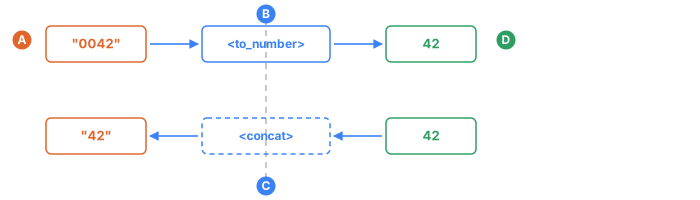
- Athe string side: a value from a <field>, digits and all
- Bthe crossing you have to write — <to_number>
- Cthe crossing that happens on its own: a number placed in <concat> becomes its digits
- Dthe number side, where arithmetic lives
<to_number> turns a digit string into an integer. It's the workhorse of
arithmetic: without it you can't add, subtract, multiply, or divide multi-digit
sequence values. A leading - is allowed ("-42" → -42); a non-digit string is an
error.
It exists because of type coercion. Sequence values
(<field name="…"/>) and ${{…}} values are strings. Arithmetic
accepts only integers: it coerces a single-digit string ("7") on its own, but
not a multi-digit one — that's an error. <to_number> is the one and only way to
say "parse this digit string into a number," and keeping it explicit stops "add as
numbers" from being confused with "glue as strings" (<concat>).
Without it — an error
Adding two multi-digit fields directly fails before any data is generated:
<sequence name="A"><gen type="number" value="10..90"/></sequence>
<sequence name="B"><gen type="number" value="10..90"/></sequence>
<sequence name="Sum">
  <compute><result><add><field name="A"/><field name="B"/></add></result></compute>
</sequence>
tdcv2: expected an integer in <add>, got the string "10" — wrap it in <to_number> to convert a multi-digit string
"10" is a two-digit string, so it isn't coerced on its own. The error message points
straight at the fix.
With it — it works
Wrap each field and the addition goes through:
<sequence name="A"><gen type="number" value="10..90"/></sequence>
<sequence name="B"><gen type="number" value="10..90"/></sequence>
<sequence name="Sum">
  <compute><result>
    <add>
      <to_number><field name="A"/></to_number>
      <to_number><field name="B"/></to_number>
    </add>
  </result></compute>
</sequence>
10 + 76 = 86
67 + 30 = 97
61 + 75 = 136
54 + 27 = 81
51 + 53 = 104
When you don't need it
A single-digit string is coerced on its own. So inside a digit walk
(<reduce>, <each>), the element
<current/> is a one-character string and can be added or multiplied
without a wrapper — which is why the "digit sum" and "weighted sum" examples above skip
<to_number>. You need the wrapper only when the number is multi-digit: a whole
field value, a ${{…}}, or a chunk from <slice>.
<encode as="…">
Takes one single-character string plus as= → gives a string.
<encode as="…"> turns a single character into its numeric code, returning the
result as a string. The as attribute picks the table. Use it when a scheme
weights letters as numbers — IBAN's mod-97, for instance, replaces each letter with its
base-36 value before the modulus.
To get a single character to feed it, pull one out of a string:
<current/> inside a walk, <slice>, or a literal
<str v="A"/>.
as | What it produces |
|---|---|
base36 | 0–9 → 0…9, letters A–Z/a–z → 10…35 (decimal) |
ascii | decimal code point, 0–127 only (otherwise an error) |
unicode | decimal code point, no 127 limit |
hex | the code point in base 16 |
octal | the code point in base 8 |
binary | the code point in base 2 |
An unknown as value is caught before the run (error TDC186).
base36 — a letter to a number
Walk a string character by character with <each>, encode each in
base36, and glue the results with <join>:
<sequence name="Codes">
  <compute><result>
    <join sep=" ">
      <each>
        <over><str v="A9z"/></over>
        <do><encode as="base36"><current/></encode></do>
      </each>
    </join>
  </result></compute>
</sequence>
A9z -> 10 9 35
A → 10, the digit 9 → 9, z → 35 (case doesn't matter). These are
decimal weights, not "base-36 digits". This is exactly the table IBAN uses before
taking mod 97.
One character in every base
The same character A (code point 65) through each table:
<sequence name="Asc"><compute><result><encode as="ascii"><str v="A"/></encode></result></compute></sequence>
<sequence name="Uni"><compute><result><encode as="unicode"><str v="A"/></encode></result></compute></sequence>
<sequence name="Hex"><compute><result><encode as="hex"><str v="A"/></encode></result></compute></sequence>
<sequence name="Oct"><compute><result><encode as="octal"><str v="A"/></encode></result></compute></sequence>
<sequence name="Bin"><compute><result><encode as="binary"><str v="A"/></encode></result></compute></sequence>
ascii    65
unicode  65
hex      41
octal    101
binary   1000001
ascii/unicode give decimal 65; hex/octal/binary give the same code point in
base 16/8/2. The result is a string — to keep computing on it, wrap it in
<to_number> (though a single base36 character feeds arithmetic
directly, since a one-character string is coerced on its own).
Limitations
- No expression strings — every operation is its own tag.
- Integers only — no floats, no booleans; a 64-bit overflow is an error, not a silent wrap.
- Tag names use
_:to_number,current_index, and so on. - Tree errors are caught before the run (codes
TDC180–TDC187): an unknown tag, a wrong child count, an unbound<use>, and the like.
See also
- Lists & iteration — sum or weight a whole list with
<reduce>. - Conditionals — branch on
<greater_than>/<mod>in a check digit. - Compute overview — the full Luhn / check-digit example.
- Compute functions reference — the alphabetical catalog.